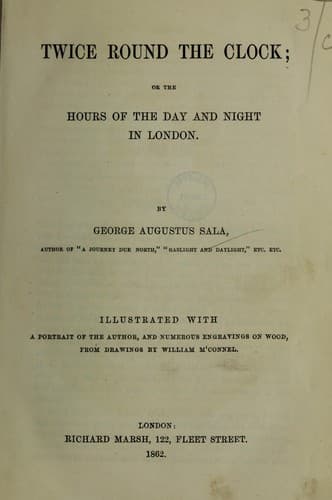
Twice round the clock; or, The hours of the day and night in LondonSala, George Augustus
General
Twice round the clock; or, The hours of the day and night in London
Sala, George Augustus
London (England) -- Social life and customs -- 19th century
systematic immorality: no, not by Wilkes; no, not by Aphra Behn: no, not
by Crebillon the younger: no, not by Voltaire in the scandalous “Pucelle.”
And have I brought you all the way over Waterloo Bridge in the evening
only to sermonise you! I deserve to be mulcted in three times the
halfpenny toll; and I must make amends by saying nothing whatsoever
about the shot towers, or the Lion Brewery, the London and South-Western
Terminus, and Hawkstone Hall. Here we are, at the corner of the New Cut.
It is Nine o’Clock precisely (I must have flown rather than walked from
the pawnbroker’s in that lane on the Middlesex side), and while the
half-price is pouring into the Victoria Theatre, the whole-price (there
is no half-price to the gallery, mind, the charge for the evening’s
entertainment being only threepence) is pouring out with equal and
continuous persistence, and are deluging the New Cut. Whither, you may
ask, are they bound? They are in quest of their Beer.
The English have been a beer-loving people for very many ages. It gives
them their masculine, sturdy, truculent character. Beer and beef, it
has been before remarked, make boys. Beer and beef won the battle of
Waterloo. Beer and beef have built railways all over the world. Our
troops in the Crimea languished, even on beef (it was but hard corned
junk, to be sure) till the authorities sent them beer. There is a _lex
non scripta_ among the labouring English, much more potent than many Acts
of Parliament, and called the “Strong Beer Act.” They have songs about
beer with lusty “nipperkin, pipperkin, and the brown beer” choruses; and
in village parlours you may hear stentorian baritones, of agricultural
extraction, shouting out that “Feayther likes his beer, he does;” that
“Sarah’s passionately fond of her beer, she is;” and denouncing awful
vengeance upon those enemies of the people who would “rob a poor man
of his beer.” Our fingers were brought to the very hair-trigger of a
revolution by the attempted interference of an otherwise well-meaning
nobleman, with the people’s beer; and did not William Hogarth strike
the right nail on the head when he drew those two terrible pictures of
Beer Street and Gin Lane? The authorities of the Victoria Theatre have
preserved, I am glad to say, a wholesome reverence for the provisions of
the Strong Beer Act, and it is, I believe, a clause in the Magna Charta
of the management, that the performances on Saturday evenings shall
invariably terminate within a few minutes of midnight, in order to afford
the audience due and sufficient time to pour out their final libations at
the shrine of Beer, before the law compels the licensed victuallers to
close.
Public-domain text, read in full here on John Shaqi.
Reviews
Reviews
No reviews yet
Be the first to share your thoughts on this work.
Elsewhere in the archive
Join the Discussion
Join the discussion
Sign in to leave a comment or review.
Sign InorCreate an account