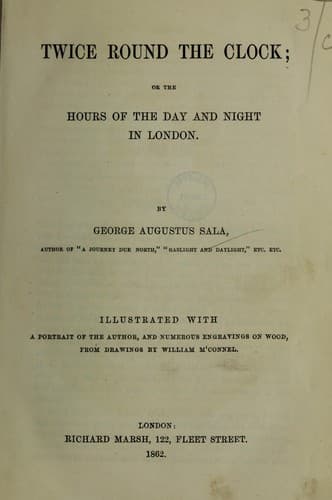
Twice round the clock; or, The hours of the day and night in LondonSala, George Augustus
General
Twice round the clock; or, The hours of the day and night in London
Sala, George Augustus
London (England) -- Social life and customs -- 19th century
I once heard a man of the world tell a lady, in gay reproach, that
there were three things impossible of accomplishment to her sex. “Women
can’t throw,” he said, “they can’t jump, and they can’t slide.” The
lady stoutly denied the third postulate, and adduced in proof her own
sliding performances in winter time in the day-room at boarding school.
The first assertion she settled by throwing the peeling of an apple at
him, which fell deftly over his left shoulder, and formed on the carpet,
I am told, the initials of her Christian name. However this may be with
other ladies—for she was fair, and good, and wise, as “Sydney’s sister,
Pembroke’s mother,” though Time has not thrown a dart at her yet, I
know there is one thing a man cannot do. He cannot dance. He may take
lessons of Mrs. Hercules Fanteague till his hair grows out of his hat,
and his nails grow out of his pumps; he may dance the Crystal Platform
at Cremorne to sawdust, but he will never succeed in making himself more
than a capering elephant, or an ambling hippopotamus, with the facial
expression of an undertaker’s man on duty for the funeral of a very
rich “party,” where extra woe is laid on by Mr. Tressels, regardless of
expense.
Of course I except professional dancers, and I bow reverentially before
the bust of Vestris, “_Diou de la Danse_” and of the late Mr. Baron
Nathan. I do not remember the first. He died years before I was born,
yet I see him in my mind’s eye on the stage of the Grand Opera in
Paris, swelling with peacock-pride and conscious merit—in dancing—in
full court-dress, his sword by his side, his laced and plumed _chapeau
bras_ beneath his arm, his diamond _solitaire_ in his laced shirt-frill,
leading his son to the footlights, on the night of the first appearance
of the youth, and saying, “_Allez_, my son, the Muses will protect you,
and your father beholds you.” Was it this son, or a grandson I—tell
me “Notes and Queries”—that was the Armand Vestris, whom our Eliza
Bartolozzi (the famous Madame Vestris) married, and who was hurried
at that dreadful hole at Naples? I see the _Diou de la Danse_ on a
subsequent occasion at rehearsal, when the same son, being committed
to the prison as Fort l’Evêque by the lieutenant of police (the whole
operatic _troupe_, led by Mademoiselle Guimard, were in a state of
chronic revolt) dismissed him with these magnanimous words: “_Allez_, my
beloved one. This is the proudest day of your life. Demand the apartments
of my friend the King of Poland. Take my carriage. Your father pays for
all!” But the poor baron, with his corkscrew ringlets, turn-down collar,
and limber legs, I can and do remember. I have seen him dance that
undying _pas_, blindfold, among the eggs and tea-things, in the Gothic
Hall at Rosherville. But five Sundays since I was at Gravesend, and over
my shilling tea in the Gothic Hall, I sighed when I thought of Baron
Nathan and of happier days. “Where art thou, my Belinda? There is no one
to pull off my shrimp-heads now.”
Public-domain text, read in full here on John Shaqi.
Reviews
Reviews
No reviews yet
Be the first to share your thoughts on this work.
Elsewhere in the archive
Join the Discussion
Join the discussion
Sign in to leave a comment or review.
Sign InorCreate an account