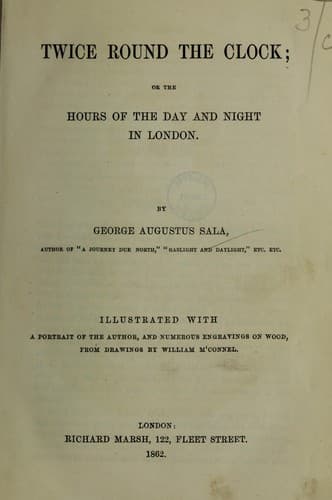
Twice round the clock; or, The hours of the day and night in LondonSala, George Augustus
General
Twice round the clock; or, The hours of the day and night in London
Sala, George Augustus
London (England) -- Social life and customs -- 19th century
Lo, as I pen these reminiscences of nine o’clock in the evening—pen them
in the “quiet street,” where I am again for a season—though my boat is
on the shore, and my bark is on the sea, and ere you hear from me again
there will be a considerable variation of clocks between London and
Jericho—a fife and tabour announce the advent of a little dancing boy
and girl, with a careworn mother, in the street below. I look from my
window, and see the little painted people capering in their spangles and
fleshings and short calico drawers. It is against conviction, and against
my own written words, and against political economy, and ex-Lord Mayor
Carden; but I think on Mr. Carrick’s picture of “Weary Life,” and must
needs take some pence from the clock-case, and throw them out to these
tiny mummers. Life is _so_ hard, my brother!
TEN O’CLOCK P.M.—A DISCUSSION AT THE “BELVIDERE,” AND AN ORATORIO AT
EXETER HALL.
Exists there, in the whole world, civilised or uncivilised, a nation
of such inveterate grumblers as the English? We grumble at everything.
We are five-and-twenty millions of bears afflicted with perpetually
sore heads. Are we charged sixpence extra for a bed? is the tail of
our mutton-chop underdone? does our mockturtle soup disagree with us?
is a railway train late? or the requisite amount of hop deficient in
our pale ale? does an Italian itinerant split our ears while we are
endeavouring to solve the Seventh Problem in the First Book of Euclid?
does the editor or manager refuse to return the manuscript of our poems
or our farces? do we buy a silk dress that turns out to be nine-tenths
cotton? are we surcharged by the commissioners of income-tax, (_they_
say I make a thousand a year, I say I don’t _make_ a hundred and
fifty; but may difference of opinion never, et cetera)? forthwith we
call for pen, ink, and paper, and indite a letter to the “Times,” that
providential safety-valve for the great legion of grumblers. What are our
public meetings but organised arenas of grumbling? what the “leaders”
in our Sunday newspapers but extra facilities for grumbling after we
have been grumbling all the week? I think it was Mr. Horace Mayhew, in
his “Model Men and Women,” who told the story of a waiter at a city
tavern, who took but one holiday in the course of the year, and then
enjoyed himself by paying a visit to another waiter at another tavern,
and assisting him in laying the knives and forks. In like manner the
ordinarily-understood holiday for the gentlemen of the daily press—there
being no diurnals published on Sunday—is Saturday; whereupon, after
lying in bed somewhat longer than usual on the sixth day’s morning, they
indulge in the _dulce desipere in loco_, by writing stinging leading
articles in the journals which publish editions on the Sabbath. This is
due to their inveterate propensity for grumbling. And, mark me, this
licensed and acknowledged grumbling is the surest safeguard of our
Public-domain text, read in full here on John Shaqi.
Reviews
Reviews
No reviews yet
Be the first to share your thoughts on this work.
Elsewhere in the archive
Join the Discussion
Join the discussion
Sign in to leave a comment or review.
Sign InorCreate an account