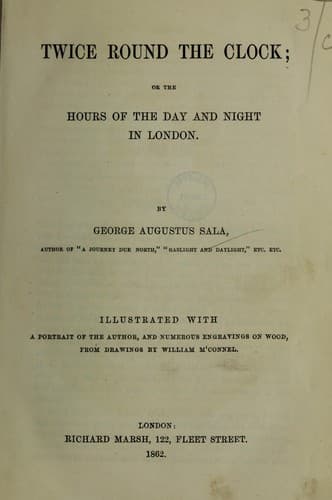
Twice round the clock; or, The hours of the day and night in LondonSala, George Augustus
General
Twice round the clock; or, The hours of the day and night in London
Sala, George Augustus
London (England) -- Social life and customs -- 19th century
liberties, and the safest guarantee for our not drifting from our snug
roadstead of constitutionalism, where we can ride at anchor, and smile
at the timid argosies and caravels of despotism, moored and chained in
the grim granite basins of the inner port, and all without launching
into the troubled oceans, full of breakers and white squalls, of utter
democracy. We seize upon a wrong, and grumble at it, till, after a few
months’, and sometimes a few years’ grumbling, we find that the wrong
exists no more, and that we have gained another Right. But we have had no
barricades _ad interim_, no fusillades, no bombardment of private houses,
no declarations of the “solidarity” of anybody, no confiscations, no
deportations, and no guillotinings. Our rulers, grown wise by experience
of smashed windows, pelted heads, and occasional (when the people were
very hard driven) political annihilation, and hurling into the limbo
of red tapism, have of late years placed few or no restrictions upon
grumbling. The noble lord at the head of the Government daily receives
deputations, who grumble at his measures, or at the measures he won’t
guarantee to propose, fearfully. In the Parliament House, no sooner does
our gracious Queen, in her silver bell-like voice, speak the speech
that others have written down for her (I daresay she could write a
much more sensible discourse herself), than Lords and Commons begin to
grumble about the sense of her words, and move amendments to the address
which is to be presented to her. Downstairs, all through the session,
parliamentary committees are grumbling at witnesses, and witnesses are
grumbling at the committee; and in outlying boroughs vicious electors are
grumbling at the members of the Commons’ House of Parliament. The country
newspapers and the London newspapers grumble. The barristers grumble at
the judge, and the judge at the jury. The public grumbles at the way
soldiers are treated by the officers, and the soldiers (who are about
the only citizens who are not addicted to grumbling) go out and fight
and win battles, at which we at home grumble, because so many lives have
been lost. And I daresay the Prime Minister grumbles because he has the
gout, and the Queen on her throne grumbles because “Punch” caricatures
the Prince Consort, and “Punch” grumbles because the Prince Consort does
not often enough give occasion to be grumbled at. I grumble at being
obliged to write for your amusement, and you grumble because I am not
half amusing enough. We grumble at the cold dinners at school, at the
price of the marriage license, at the doctor’s bill for our first child’s
measles, at the cost of the funeral of Uncle John, who left us all his
money. We grumble because we have to live, and grumble when the physician
tells us that we must die. Does it not all resolve itself into our purer,
better Fielding’s aphorism in “Vanity Fair”—“Ah! _vanitas vanitatum_? Who
of us has not his hobby, or, having it, is satisfied?” Yet there is much
Public-domain text, read in full here on John Shaqi.
Reviews
Reviews
No reviews yet
Be the first to share your thoughts on this work.
Elsewhere in the archive
Join the Discussion
Join the discussion
Sign in to leave a comment or review.
Sign InorCreate an account