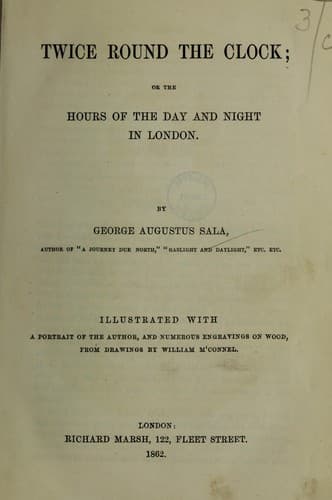
Twice round the clock; or, The hours of the day and night in LondonSala, George Augustus
General
Twice round the clock; or, The hours of the day and night in London
Sala, George Augustus
London (England) -- Social life and customs -- 19th century
Ere I leave these placid tribunes of Pentonville Hill, discharging their
harmless philippics at men high in place and power, I muse a little
over the tavern itself, and call to mind a certain story I once heard
respecting it, possessing what foundation of truth I know not, but which,
if not true, is assuredly _ben trovato_. Thus runs the dubious legend:
You remember the fair young daughter of England, the good princess, the
virtuous daughter of a wicked father, and in whom, from her cradle to
her marriage, the hope and love of this stolid but strong-feeling nation
were centred. You remember her husband: he is a king at Brussels now. You
remember how, when she died, all England burst into a passionate lament;
how thousands went into voluntary mourning; how clergymen wept in the
pulpit, when they discoursed on her virtues; how an awful darkness and
despair seemed to overshadow the ill-governed land when the news came
that the Princess Charlotte was dead. There is little need to say that
her husband (who, I am glad to believe, loved her very truly and fondly)
was at first inconsolable for her loss, and grieved long and bitterly
for her. But time was good to him, and heaven merciful, and by degrees
his sorrow wore away. Still he was melancholy, pre-occupied, and loved
nothing so much as to be left alone. It was about this time that the
then landlord of the Belvidere began to notice that about eleven o’clock
almost every forenoon during the week a gentleman in deep mourning, and
on horseback, would stop at the door of the tavern, leave his horse in
charge of his groom, enter the large room, call for a pipe and a pint
of ale, and quietly enjoy those refreshments for about the space of one
hour. The room would be at that early hour of the day almost deserted.
The one or two tradesmen who would occasionally drop in for a crust of
bread and cheese, and a peep at the “Times,” would be bidden a civil
“good morning”—in a slightly foreign accent—by the stranger; but he
never entered into conversation; he never read the newspaper; he “kep
hisself to hisself,” the waiter said. But he was so punctual and so
regular in his attendance, that the people of the house came to look out
for his daily visit in his suit of sables, and a special pipe was laid,
a special dish of tobacco prepared, and a special chair and spittoon
arranged, every day for his use. So things went on for many weeks; till
one luckless morning, just after the departure of the black horseman, a
customer of the house—I believe he was a commercial traveller, who had
just returned from a journey in the west of England, and who had been
enjoying his pipe and pint in the society of the taciturn stranger—called
the landlord on one side.
“Do you know who that chap is?” he asked.
“Not a bit,” answered the host. “Comes here every morning regular. Pint
of mild sixpenny; bird’s-eye; gives the waiter twopence, and goes away.
Groom has a glass of ale sitting on his horse. Pays his way like a
gentleman.”
Public-domain text, read in full here on John Shaqi.
Reviews
Reviews
No reviews yet
Be the first to share your thoughts on this work.
Elsewhere in the archive
Join the Discussion
Join the discussion
Sign in to leave a comment or review.
Sign InorCreate an account