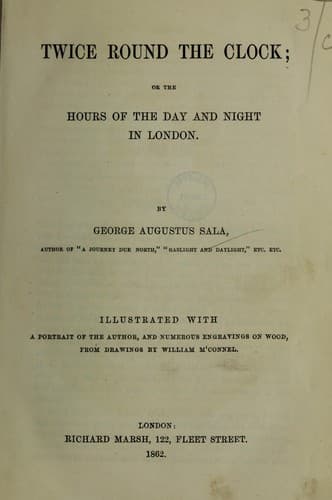
Twice round the clock; or, The hours of the day and night in LondonSala, George Augustus
General
Twice round the clock; or, The hours of the day and night in London
Sala, George Augustus
London (England) -- Social life and customs -- 19th century
“He’s somebody,” said the commercial traveller, significantly.
“So I should think,” returned the landlord, quietly.
“He’s a high fellow,” added the bagman, mysteriously.
“I shouldn’t wonder,” said the landlord, tranquilly.
“Why, bless your heart, man alive!” broke out, impatiently, his
interlocutor, “can’t you guess who he is? He’s Prince Leopold of
Saxe-Coburg. I have seen his Royal Highness a hundred times, and know him
by sight as well as I do you.”
The next forenoon, when the sable horseman arrived, he found a roll of
crimson baize laid down from the pales before the tavern to the doorway,
which was lined by American aloes in tubs. The staircase was freshly
carpeted; in the stranger’s customary place was a table covered with a
crimson cloth, backed by a crimson chair with gilt legs. The landlady,
her daughter, and the barmaid, were all in holiday attire, and when the
unknown rang the bell, the landlord himself, in a blue coat and brass
buttons, and his hair newly powdered, brought him the beer in a silver
tankard, and a wax candle at which to light his pipe. The black horseman
said nothing, drank his ale, and smoked his tobacco, paid his reckoning,
made his way downstairs amidst a profusion of bows and curtsies, mounted
his horse, and—never came again. So runs the legend. The commercial
traveller may have been wrong in his assertion, or may have been hoaxing
the landlord; but I incline to the belief that this was really Prince
Leopold. Why not? The incident is trifling enough; yet there is something
touching in the picture of the good-natured young German brooding over
his bereavement, yet consoling himself in the simple German fashion, over
his pipe and beer.
* * * * *
Friend of mine, if you have the slightest hope or thought that whither
I am now taking thee is one of the gay and merry scenes of London
night-life, prithee dismiss the thought, for thou art in error. Prithee
pull up the collar of thy coat, stiffen thy neckcloth as much as
possible, take that wicked cigar from thy mouth, cast down thine eyes,
and assume a decorum, if thou have it not. We are going to Exeter Hall.
Don’t be alarmed: this is not the month of May or the season for meetings
in aid of missions to the Quashiboos, the Rumbatumbas, or the Oolalooloo
cannibals. We are not going to hear John B. Gough lecture on temperance.
We are going to hear an oratorio, conducted by Mr. Costa—an oratorio in
which Mr. Sims Reeves, Mr. Weiss, Miss Dolby, and Madame Clara Novello,
are to sing—and to listen to a band and chorus brought to a degree of
perfection which only the genius of such a conductor could insure, or the
gigantic resources of the Sacred Harmonic Society command.
Public-domain text, read in full here on John Shaqi.
Reviews
Reviews
No reviews yet
Be the first to share your thoughts on this work.
Elsewhere in the archive
Join the Discussion
Join the discussion
Sign in to leave a comment or review.
Sign InorCreate an account