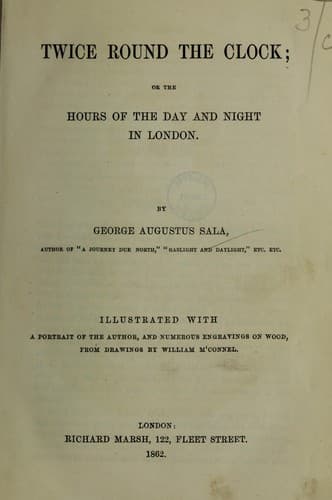
Twice round the clock; or, The hours of the day and night in LondonSala, George Augustus
General
Twice round the clock; or, The hours of the day and night in London
Sala, George Augustus
London (England) -- Social life and customs -- 19th century
They think differently in England. To the seriously-inclined middle
classes the oratorio supplies the place of the opera. And it behoves you
to consider what a vast power in the state those serious middle-class
men and women are. It is all very well for us, men and citizens of the
world, yet living in a comparatively contracted circle of acquaintances
as cosmopolitan as ourselves; it is all very well for us, who see “no
harm” in sitting at home and reading the newspaper, while our wives
go to church; who support Sunday bands, Sunday steamboats, and Sunday
excursion trains, and are agitating now for the opening of museums,
and galleries, and palaces on the Sabbath; who talk lightly on serious
topics, and call clergymen parsons; it is all very well, I say, for
us, travelled, and somewhat cynical as we may be, to pretend that the
“serious” world is an amalgam of bigotry, hypocrisy, and selfishness,
and to ignore the solemn religious journals that denounce hot dinner
on Sundays, or a walk after it, or the perusal of a secular book on
the sacred day, as intolerable sins. Yet how many thousands—how many
millions—of sober, sincere, conscientious citizens are there, who are
honestly persuaded of the sinfulness of many things which we consider
harmless recreations! who would shrink back in horror, if they heard
a tithe of the conversations that go on every night in hundreds of
well-conducted London drawing-rooms! who look upon dancing as an
irreligious and Babylonish pastime! whose only light reading consists
of tracts, missionary chronicles, and memoirs of sainted cheesemongers,
and the beatified daughters of dairymen! I declare that I never see a
theatre in a country town—where, at least, two-thirds of the population
consist of such as I have described—without wondering at the lunacy of
the person who built it, without marvelling at the idiocy of every fresh
speculator who enters on the management. We may pretend to despise the
Puritan world, write books and farces against them, and quiz the “Record”
or the “Wesleyan;” but it is folly to ignore the vast numerical strength
of these same Puritans. They purchase such books as “Memorials of Captain
Headly Vicars” by thousands; they subscribe thousands of pounds yearly
in an almost insane hope of converting heathen barbarians to a better
faith; they give away millions of tracts; they flood the platform and the
auditory of every public meeting. It won’t do to ignore them. Cromwell’s
Ironsides and Sir Harry Vane’s Fifth-Monarchy Men have made too deep a
mark upon the people of England to be lightly passed over.
Public-domain text, read in full here on John Shaqi.
Reviews
Reviews
No reviews yet
Be the first to share your thoughts on this work.
Elsewhere in the archive
Join the Discussion
Join the discussion
Sign in to leave a comment or review.
Sign InorCreate an account