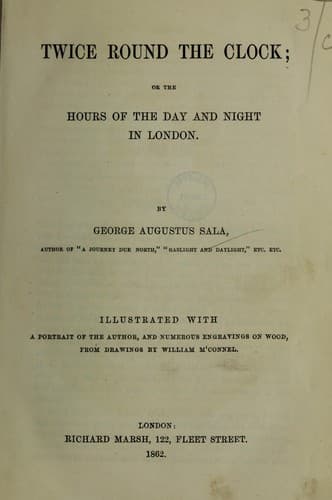
Twice round the clock; or, The hours of the day and night in LondonSala, George Augustus
General
Twice round the clock; or, The hours of the day and night in London
Sala, George Augustus
London (England) -- Social life and customs -- 19th century
There would seem to be in an oratorio something essentially germane to
the English mind and character. The sounding recitative and swelling
hymns, the rolling choruses and triumphant bursts of exultant music,
have a strange affinity with the solemn, earnest, energetic English
people, slow to move to anger or to love, but, when moved, passionately
enthusiastic in their love, bloody and terrible in their great wrath. The
French can no more understand oratorios than they can understand blank
verse. I remember going to see Mendelssohn’s “Elijah” once in Paris. It
was winter time, and the performances took place in Franconi’s great,
windy, for-summer-built horse-riding circus in the Champs Elysées. The
band and chorus shivered as they scraped and sang; the _prima donna’s_
nose and lips were blue, and the music paper quivered in her hand; the
_contralto_ looked exquisitely uncomfortable at not having to wear a
page’s dress and show her legs. As for the audience, the ladies sat
muffled up in shawls and furs—it was a morning performance—and whispered
among themselves; the men sucked the knobs of their canes, twirled their
moustaches, stared up at the chandeliers, and murmured, _Quelle drôle de
musique_! They didn’t repeat that oratorio, and I don’t wonder at it.
To the French it was neither fish nor flesh, neither ecclesiastical nor
secular. If the first, they might argue, give us the chanting priests,
the swinging censers dispensing fragrant clouds, the red-cassocked altar
boys, the twinkling tapers, the embroidered canopies, and the swelling
pæans of the concealed choristers. If the last, let us have a drinking
chorus, a laughing chorus, and a dagger chorus, a _prima donna_ to make
her entrance on horseback, a _contralto_ in tights, a ballet in the
second act, and some red fire at the end. But this is neither mass nor
opera.
Public-domain text, read in full here on John Shaqi.
Reviews
Reviews
No reviews yet
Be the first to share your thoughts on this work.
Elsewhere in the archive
Join the Discussion
Join the discussion
Sign in to leave a comment or review.
Sign InorCreate an account