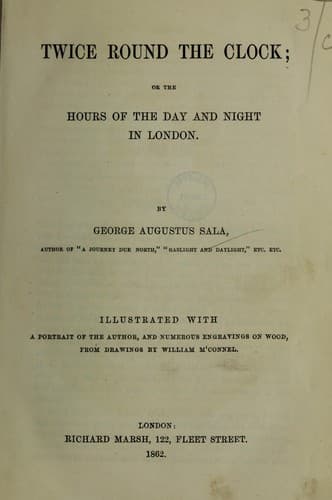
Twice round the clock; or, The hours of the day and night in LondonSala, George Augustus
General
Twice round the clock; or, The hours of the day and night in London
Sala, George Augustus
London (England) -- Social life and customs -- 19th century
Glancing over my map of London, and retracing the course of our
peregrinations, I find, with some complacency, that we have not, after
all, left many parts of the metropolis unexplored. We have been to
Camberwell and to Hyde Park Corner; to Pentonville and to London Bridge;
to Billingsgate and to Euston Square. It is true, that we have not yet
penetrated to the interior of Buckingham Palace, or the condemned cell at
Newgate, nor do I think that I shall assume the part of the Boy Jones or
a visiting magistrate for your amusement; but we have been “behind the
scenes” of more places than theatres since this clock was first wound up.
It is not without regret now, that I linger over and dally with my few
remaining hours. They have been very pleasant ones for me. I shall miss
the printer’s boy (for, be it known, I am about to abandon literature and
go into trade, though I have not yet settled the precise business—corn,
or coals, or commission agency). I shall miss, beyond aught else, the
daily deluge of letters from anonymous correspondents—praising, blaming,
complaining, or inquiring, but all, I am glad to say, very appreciative
readers of my shiftless writings.
But we have come to the complexion of midnight, and the hour must be
described. It is fraught with meaning for London. You know that in
poetical parlance midnight is the time when church-yards yawn (they
had need to be weary now, for the Board of Health won’t allow them to
receive any occupants _intra muros_), and graves give up their dead. And
there be other grave-yards in London town—yards where no tombstones or
brick vaults are—that at midnight yawn and send forth ghosts to haunt
the city. A new life begins for London at midnight. Strange shapes
appear of men and women who have lain a-bed all the day and evening,
or have remained torpid in holes and corners. They come out arrayed in
strange and fantastic garments, and in glaringly gaslit rooms screech and
gabble in wild revelry. The street corners are beset by night prowlers.
Phantoms arrayed in satin and lace flit upon the sight. The devil puts a
diamond ring on his taloned finger, sticks a pin in his shirt, and takes
his walks abroad. It is a stranger sight than even the painter Raffet
imagined in his picture of Napoleon’s midnight review, and it is, I
think, a much better thing to be at home and in bed, than wandering about
and peeping into the mysteries of this unholy London night life.
I know this book (to my sorrow) well; have conned its grim pages, and
studied its unwholesome lore, attentively. But I am not about to make
you a too-recondite participant in my knowledge. Were it not that
the appointed hours were meted out to me, and that from one of the
hours—midnight—the Haymarket is inseparable, the wicked street should
find no place here; but I must be faithful to my trust, and the bad
thoroughfare must be in part described.
Public-domain text, read in full here on John Shaqi.
Reviews
Reviews
No reviews yet
Be the first to share your thoughts on this work.
Elsewhere in the archive
Join the Discussion
Join the discussion
Sign in to leave a comment or review.
Sign InorCreate an account