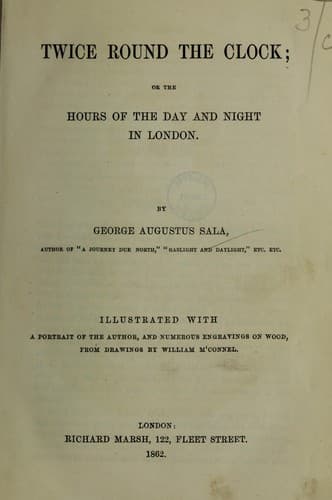
Twice round the clock; or, The hours of the day and night in LondonSala, George Augustus
General
Twice round the clock; or, The hours of the day and night in London
Sala, George Augustus
London (England) -- Social life and customs -- 19th century
Foreigners have frequently pointed out to me a peculiar aspect of London,
and one which appeals strongly to the observant faculties, and which,
nevertheless, may escape us Cockneys who are to the metropolitan manner
born. It is the duality of the huge city, not so much as regards its
night and day side, as in its Sunday and week-day appearance. And this
is not wholly to be ascribed to the shop shutters being closed. The
Strand on Ash Wednesdays and Good Fridays is still the Strand; but on the
Sabbath it would seem as though every house in the West and East ends had
put on its special Sunday suit, and had decorated itself with a certain
smug spruceness quite marked and distinct. You have a difficulty in
recognising your most familiar streets. Regent Street is quite altered.
The aspect of Piccadilly is entirely changed; and Cheapside is no more
like the Cheapside of yesterday than Hamlet is like Hecuba. The people,
too, are not by any means the same people you meet on week-days. Not only
their clothes are different, but their faces, their manners, their very
gait and bearing, seem changed. You meet people out walking on Sundays,
who during the week are confined to places where they are hidden from
the public gaze, or are at most but half visible. You see the bar-maids’
skirts and the pawnbrokers’ legs on Sundays. From Monday to Saturday you
can see but their busts. You may nod to a sheriff’s officer on Sunday
without entertaining any apprehensions as to the piece of paper he may
have against you in that dismal black leather pocket-book of his. The
omnibus roofs are covered, the steamboats’ decks are crowded, the cabs
full, the pavement thronged, the very saddle-horses bestridden by men who
seem of a different race to the outside world of the previous four and
twenty hours. Dirty streets look clean; disreputable streets decorous;
and thoroughfares that were as still as mice during the week, become
quite noisy on Sundays with carriage and cab wheels, as sinners of wealth
and distinction rattle up to the doors of the fashionable chapel.
Public-domain text, read in full here on John Shaqi.
Reviews
Reviews
No reviews yet
Be the first to share your thoughts on this work.
Elsewhere in the archive
Join the Discussion
Join the discussion
Sign in to leave a comment or review.
Sign InorCreate an account