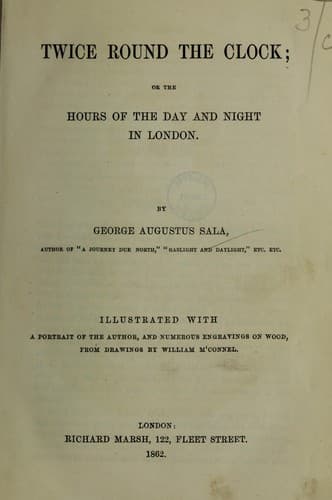
Twice round the clock; or, The hours of the day and night in LondonSala, George Augustus
General
Twice round the clock; or, The hours of the day and night in London
Sala, George Augustus
London (England) -- Social life and customs -- 19th century
Or, “another way,” as old Mrs. Glasse says in her cookery book. At the
Coventry Street extremity of the Haymarket stands that celebrated and
long-established institution known as the Royal Albert Potato Can. At
that three-legged emporium of smoking vegetables, gleaming with block tin
painted red, and brazen ornaments, the humble pilgrim of the Haymarket
may halt and sup for a penny. For a penny? What say I? for a halfpenny
even, may the belated and impoverished traveller obtain a refreshment at
once warm, farinaceous, and nourishing. Garnish your potato, when the
Khan of the Haymarket has taken him from his hot blanket-bed, and cut
him in two—garnish him with salt and pepper, eschew not those condiments,
they are harmless, nay, stimulating; but ho! my son, beware of the
butter! it is confusion. Better a dry potato and a contented mind, than
dreadful Irish salt grease—for butter I dare not call it, which may give
you a bilious attack that will last for a month.
I should like to know what has been the use of my recommending these
various grades of supper to you, from the lordly Café de l’Europe to the
humble Potato Can, when I should have known all along, and as it were
intuitively, that your mind was bent upon oysters, and that oysters after
the play you were determined to have. Come along, then, a’ goodness’
name, and if oysters are to be the order of the night, e’en let us have
them.
The London oyster, or rather shell and cured fish shop, for the sale
of lobsters, crabs, pickled and kippered salmon, bloaters, and dried
sprats, is combined with that of the delicious molluscs of which so
many thousands are nightly consumed; the London oyster-shop, and
particularly the Haymarket one, stands, and is a thing apart, among
the notabilia of this metropolis. You know how the French eat oysters.
There is the _belle écaillère_, generally a hideous old woman of about
sixty, with a snuffy-looking pocket-handkerchief twisted round her
head, who sits at the _restaurant_ door amid a grove of oyster-shells
and hanks of straw, and, in the intervals of oyster-opening, darns
worsted stockings. The nimble _garçons_ come skipping from the gilded
saloons of the _restaurant_ within, and demand their required dozens and
half-dozens from the _écaillère_ without. The bearded frequenters of
the _restaurant_ evidently think it an epicurean and fashionable thing
to commence, or rather precede dinner, by swallowing so many oysters.
There are enterprising _bon vivants_ who will even go so far as their
two dozen: but I dissent from them, for three reasons: The first, that,
in my opinion, oysters should be eaten either alone—of themselves, by
themselves, or for themselves—or that they should be consumed full twenty
minutes before the repast; for the second, that all French oysters,
whether of Ostend, Maremnes, or Canale, are to me utterly abominable,
having—even when they are fresh, which is seldom—a certain coppery
Public-domain text, read in full here on John Shaqi.
Reviews
Reviews
No reviews yet
Be the first to share your thoughts on this work.
Elsewhere in the archive
Join the Discussion
Join the discussion
Sign in to leave a comment or review.
Sign InorCreate an account