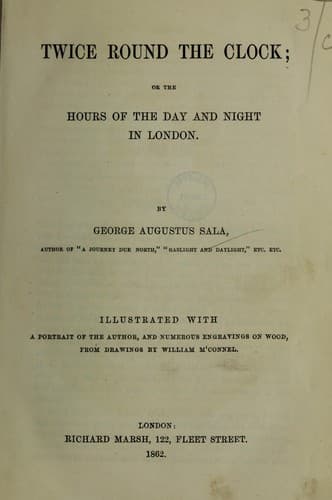
Twice round the clock; or, The hours of the day and night in LondonSala, George Augustus
General
Twice round the clock; or, The hours of the day and night in London
Sala, George Augustus
London (England) -- Social life and customs -- 19th century
flavour, superlatively nauseous; for the third, that in the best French
_restaurants_, it is difficult, if not impossible, to procure Cayenne
pepper; and, without that rubicund condiment, I would give no more for
the best “natives” than for a plate of cold boiled veal without salt. The
_écaillère_ element is the only one prevalent in France relative to the
sale of oysters, and the consumers pick them off the shells with little
silver pitchforks, squeeze lemon over them, and eat them daintily in many
mouthfuls. Fie upon such miminy-piminy ways! Oyster-shops the French
don’t seem to understand at all. At Chevet’s, that vast comestible shop
in the Palais Royal, they keep oysters, and lobsters, and prawns, and
shrimps—keep them as a show in the windows for a week or two, when, their
novelty beginning to wear off, they are disposed of, I presume, to the
nobility and gentry. They tell a story of a Frenchman, who hoarded up his
money, in order to purchase _un homard magnifique_, which he had seen at
Chevet’s, and to which he had taken a fancy.
[Illustration: MIDNIGHT: SUPPER-ROOMS IN THE HAYMARKET.]
Americans tell me that though the oyster attains high perfection,
and is held in culinary reverence as high, in the States, anything
resembling our Haymarket oyster-shop is not to be found in New York. But
on Broadway Pavement, during the gay night, brilliant lamps, sometimes
coloured in fantastic devices, invite you to enter underground temples
of oyster-eating. These are called oyster-cellars. Some are low and
disreputable enough, and not impassible to imputations of gouging,
bowie-kniving, and knuckle-dusting; but others are really magnificent
suites of apartments, decorated with mirrors and chandeliers, and glowing
with gilding, mahogany, and crimson velvet; and here you may consume
oysters as small as periwinkles or as large as cheese-plates—oysters
of strange and wondrous flavours—oysters with _bizarre_ and well-nigh
unpronounceable names—oysters cooked in ways the most marvellous and
multifarious: stewed, broiled, fried, scolloped, barbacued, toasted,
grilled, and made hot in silver chafing dishes like the delicious
preparation known as “despatch lobster.” You wash down suppers in
oyster-cellars such as these with Hock and Champagne; yet for all the
splendour and the rarity of the cooking, and the variety of oysters,
I will abide by the Haymarket oyster-shop, rude, simple, primitive as
it is, with its peaceful concourse of customers taking perpendicular
refreshment at the counter, plying the unpretending pepper-castor, and
the vinegar-cruet with the perforated cork, calling cheerfully for crusty
bread and pats of butter; and, tossing off foaming pints of brownest
stout, (pale ale—save in bottles, and of the friskiest description—is,
with oysters, a mistake) contentedly wipe their hands on the jack-towel
on its roller afterwards.
* * * * *
Public-domain text, read in full here on John Shaqi.
Reviews
Reviews
No reviews yet
Be the first to share your thoughts on this work.
Elsewhere in the archive
Join the Discussion
Join the discussion
Sign in to leave a comment or review.
Sign InorCreate an account