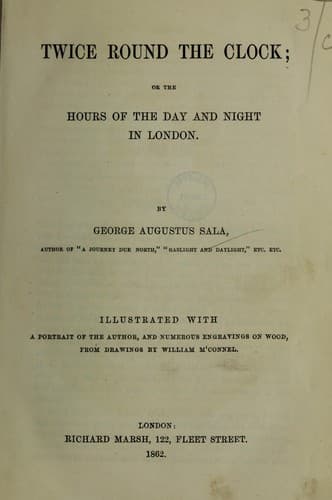
Twice round the clock; or, The hours of the day and night in LondonSala, George Augustus
General
Twice round the clock; or, The hours of the day and night in London
Sala, George Augustus
London (England) -- Social life and customs -- 19th century
As in this real life of ours, Old Age and Infancy often meet on neutral
ground, and the prattle of the child goes forth with hand out-stretched
to meet the graybeard’s maundering: so, oh reader, do I find the
beginning and the end of these papers drawing closer and closer together.
Ere many hours they will meet; and their conjunction shall be the signal
for their decay. You will remember how, when the day was very young,
the morning scarce swaddled, and kicking in his cradle with encrimsoned
heels (Aurora, the nurse, had chafed them), we visited a great newspaper
office, and saw the publication of the monster journal. Now, when
midnight itself is fallen into the sere and yellow, we stand once more
within the precincts of journalism. This is not, however, the monster
journal that has all Printing House Square to roar and rattle in. No:
our office is in the Strand. We are free of the charmed domains. We pass
up a narrow court running by the side of the office, push aside a heavy
door, ascend the creaking staircase, and discreetly tapping at a door,
this time covered with green baize, find ourselves in the presence of Mr.
Limberly, the sub-editor of the “Daily Wagon.”
Let us cast a glance round the room. What a litter it is in, to be
sure! what piles of newspapers, home and country ones, mangled and
disembowelled by the relentless scissors, cumber the floor! More
newspapers on shelves—old files, these—more on the table; letters
opened and unopened, wet proof-sheets, files of “copy,” books for
review, just sent by the publishers, or returned by the reviewers,
after they have duly demolished the contents and the authors. And all
about the room are great splashes and dried-up pools of ink, and the
ceiling is darkened with the smoke of innumerable candles—gas was, until
very lately, considered anything but orthodox in a newspaper office,
and many sub-editors still find its sharp, harsh, flickering, though
brilliant light, far inferior to the honest, though evil-smelling, old
tallow-candles, in their tin sconces and japanned shades. The “Daily
Wagon,” be it understood, is a newspaper of the good old Conservative
way of thinking—no Liberal notions, or humbug of that sort: Church
and State, strict constitutional and social discipline (including
game-laws, religious disabilities, church-rates, unequal taxation, rural
justices’ justice, and flogging in the army and schools)—the True Blue
British line of politics, in fact. Thus situated, the “Wagon,” one of
whose proprietors is said to be a peer, another a bishop, and a third
a brewer—nothing could be more respectable—sticks to its old office,
its old rooms, and its old staff. The two former have not been painted
within the memory of man; though it must be admitted that the latter
wash quite as frequently as the _employés_ of the “Morning Cracker,”
with its bran-new offices, its bran-new furniture, its bran-new type,
paper, machines, writers—bran-new everything but ideas. The “Daily
Public-domain text, read in full here on John Shaqi.
Reviews
Reviews
No reviews yet
Be the first to share your thoughts on this work.
Elsewhere in the archive
Join the Discussion
Join the discussion
Sign in to leave a comment or review.
Sign InorCreate an account