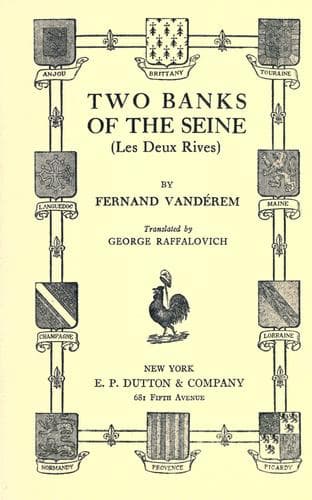
Two banks of the Seine (Les Deux Rives)Vandérem, Fernand
General
Two banks of the Seine (Les Deux Rives)
Vandérem, Fernand
Paris (France) -- Social life and customs -- 19th century -- Fiction
"Not at all, my dear sir!" M. Raindal protested. "What is essential is
that one should love the idea of the subject with which one deals, love
love, if it is of love that one is writing.... The warmth of sympathy
warms everything.... Our works are like our children. Only those which
we do not love as we conceive them are cold and unsatisfying."
Slowly he went back to his study, while Boerzell smiled at Thérèse. In
the course of their frequent conversations, the young savant had
obtained little fragmentary confidences which left him no doubts
concerning the worldly indiscretions of the master.
On the fourth Sunday, M. Raindal did not come to the drawing-room. He
had gone out, ostensibly to visit the director of the Collège, but in
reality to go to make sure that his little pupil had not returned to her
house without giving him warning. The sight of the closed shutters
destroyed his hopes. Nevertheless he rang the bell repeatedly, but no
answer came. Yet the first days of May had arrived! When would she come
back? He walked slowly along the half-deserted streets. Everything he
saw brought him some painful recollection. How often he had passed these
places, with his soul and eyes still softened by Mme. Chambannes'
sweetness! What a change now? How forsaken he was! To rid himself of
such sorrowful thoughts or to oppose them by a physical denial from his
own lips, he smiled all the way at the little girls and the little boys
in their Sunday clothes, whom their parents lazily dragged by the hand.
When the master returned home, Boerzell had not gone yet but was still
chatting with Thérèse. Near them, Mme. Raindal was reading a pious book.
The master attempted to appear in a merry mood. The recent misfortune of
one of his colleagues whose trust had been abused by forgers served him
as a pretext to scoff at the learned. After all, what was the value of
brute science if it was not animated by the spirit? What would his next
work be, for instance, if M. Raindal did not prop it up with general and
human considerations? Boerzell agreed completely and by a clever
digression he brought the conversation back to the social rôle of love.
The master took the bait eagerly. His nerves were voluptuously relaxed
by this pleasant contest of dialectics against so subtle an adversary.
The night fell before he had ended his discourse.
"You will dine with us, won't you, M. Boerzell?" he said, when Brigitte
came to light the lamp.
He only let the young man go at eleven o'clock, dazed by the contest and
so tired that he could only stammer. But this melancholy seized him
again as soon as he was alone with his daughter. He hardly said
good-night and rushed to his bed as if toward a distraction, an asylum
of forgetfulness.
The next morning he did not rise until half past eight. There was
nothing from Mme. Chambannes in his mail. Peevishly, he was splashing
water over his face, when Brigitte suddenly entered.
"A telegram for monsieur...."
Public-domain text, read in full here on John Shaqi.
Reviews
Reviews
No reviews yet
Be the first to share your thoughts on this work.
Elsewhere in the archive
Join the Discussion
Join the discussion
Sign in to leave a comment or review.
Sign InorCreate an account