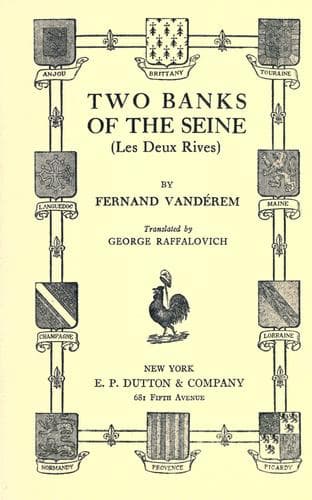
Two banks of the Seine (Les Deux Rives)Vandérem, Fernand
General
Two banks of the Seine (Les Deux Rives)
Vandérem, Fernand
Paris (France) -- Social life and customs -- 19th century -- Fiction
M. Raindal proposed to establish by means of examples that their great
social moving force was the search after pleasure and especially the
so-called gallant pleasures: the whole effort of human labor tended
towards woman and her conquest. The refinements, especially, and all the
arts often owed to her their birth and always their prosperity. It was
for woman that the stones were set in gold, the silks embroidered and
all the melodies resounded. M. Raindal meditated upon these developments
so much that he had more than once fallen a prey to fever and headaches.
At his call, the facts jumped out of their cells and rushed to line
themselves in battle array as if they were well disciplined little
soldiers. There was notably one chapter--Chapter VI--on _Love and
Gallantry in Ancient Egypt_ based on the religious legends, the toilet
paraphernalia and the popular stories which had been discovered, and of
which the master already possessed the main line and almost every
paragraph.
There were days, however, when he conceived certain scruples concerning
the value of his idea. Would not people charge him with pursuing the
same attempt at scandal which his last book had inaugurated? Would they
not reproach him with lingering purposely in immoral episodes? Did he
even possess the gift, the necessary competency to fathom the prodigious
problems of sentiment?
The first two queries M. Raindal rejected wholly in the name of the
contempt which a lofty soul owes to insinuations that are prompted by
jealousy.
The third one seemed to him more delicate a subject and more likely to
give rise to controversies. He delighted in discussing it with Boerzell,
who never failed to come every Sunday to pay the permitted call in the
rue Notre-Dame-des-Champs.
"Sincerely, M. Boerzell," he asked, "do you think that a man needs to
have been a libertine to properly appreciate the subtleties of
sentiment? Do you believe, in short, that to speak competently of love
it is necessary that a man should be a specialist in it, a professional,
a practitioner, as it were?"
"Oh, master!" Boerzell replied cautiously, "that's a complex
question.... I must say it's one I haven't considered...."
"Don't you think," continued M. Raindal, "that a multitude of sentiments
exist which one appreciates all the better for not having felt them
oneself?"
"That is incontestable!" Boerzell answered.
"You observe that in this matter one is able to retain a freshness of
impression, a preciseness of view which prove to be of the highest value
in scientific analyses.... One is not blinded either by vanity or by the
intervention of personal recollections.... The mind retains, intact, its
impartiality, its penetration, and the calm which is indispensable for
regular observations...."
"Surely, master!" Boerzell admitted. "Nevertheless don't you fear that a
certain coldness might result from this procedure?"
Public-domain text, read in full here on John Shaqi.
Reviews
Reviews
No reviews yet
Be the first to share your thoughts on this work.
Elsewhere in the archive
Join the Discussion
Join the discussion
Sign in to leave a comment or review.
Sign InorCreate an account