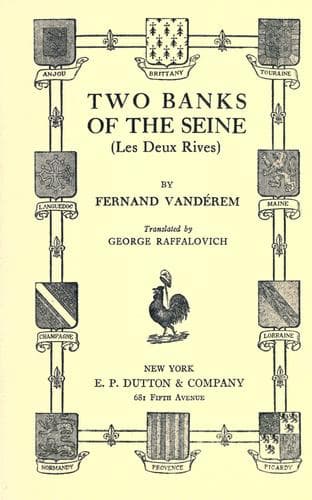
Two banks of the Seine (Les Deux Rives)Vandérem, Fernand
General
Two banks of the Seine (Les Deux Rives)
Vandérem, Fernand
Paris (France) -- Social life and customs -- 19th century -- Fiction
Oh! Had he been so very much at fault this morning? Considering it
calmly and at a distance, he did not regret that mad kiss, that
indiscreet caress which had been at least open enough to deserve
respect. Why should he try any longer to hide those sentiments of his
which were so sincere? Why affect indifference, when it was the very
reverse which Mme. Chambannes inspired him with?... Love? Oh, no. But a
certain tenderness, a certain affection, which although it was not
exclusively paternal, nevertheless did not go beyond the limits
authorized by the difference in age between a very young woman and a man
of advanced years. What was the use of concealing by subterfuge and
illusory lies, the liveliness of this inclination? Was not history full
of such examples? Without mentioning Ruth and Boaz, whose romance it
seemed had had a bourgeois ending, could he not mention a great number
of masters who had most absolutely fallen in love with their disciples,
men or women, in spite of the unlikeness of their minds and the
difference in their ages? What was there, for instance, in common
between the mind of a Socrates and that of an Alcibiades?...
The sweet melody which Delilah murmured to Samson followed just in time
to draw the master away from such risky comparisons. The play was
approaching its climax. At the fall of the curtain the Philistine
soldiery silently surrounded the little house where the betrayed hero
slept. M. Raindal recited softly to himself the never-to-be-forgotten
stanza:
"Une lutte éternelle, en tout temps, en tout lieu,
Se livre sur la terre, en présence de Dieu,
Entre la bonté d'Homme et la ruse de Femme...."
He went on with it, and Mme. Chambannes declared the lines very pretty.
She wished to know the name of the author.
"It is from Vigny, madame!" said M. Raindal, as he joined her in the
little salon at the back of the box.
Chambannes went out. They remained alone. M. Raindal asked himself
whether it would do to repeat his kiss of the morning, if only to
signify to Mme. Chambannes that his new intentions persisted. But
finding himself still slightly irresolute, he thought it best to remain
on the safe ground of literary conversation.
Just as he was beginning to tell of the tragic love affair between de
Vigny and Mme. Dorval, however, the door was suddenly pushed open. A
tall dark man stood at the entrance of the box. M. Raindal saw nothing
at first but his black moustache and his big laughing eyes.
"Ah, M. de Meuze!... Come in!" Mme. Chambannes exclaimed, with ready
ease.
Nevertheless she blushed, and between her eyelashes came such a
caressing, joyous, submissive look directed toward Gerald that M.
Raindal felt suddenly hurt. He wanted to join their conversation,
criticize the players and praise the music. But the words refused to
come at his bidding. A sudden rush of ill humor flooded his inspiration.
He got up.
"Are you going out, dear master?" Zozé asked.
Public-domain text, read in full here on John Shaqi.
Reviews
Reviews
No reviews yet
Be the first to share your thoughts on this work.
Elsewhere in the archive
Join the Discussion
Join the discussion
Sign in to leave a comment or review.
Sign InorCreate an account