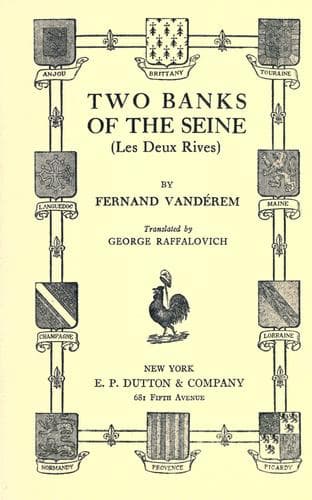
Two banks of the Seine (Les Deux Rives)Vandérem, Fernand
General
Two banks of the Seine (Les Deux Rives)
Vandérem, Fernand
Paris (France) -- Social life and customs -- 19th century -- Fiction
"Oh, just for one minute to stretch myself and get some fresh air."
He had unwittingly banged the door. He wandered aimlessly along the
passages until he came to the loggias of the staircase.
"You!" Chambannes exclaimed, as he came forward to meet him.
M. Raindal replied dully:
"Yes, it was too warm in that little room.... I left your wife with M.
de Meuze, junior, or rather, if you prefer, the son...."
Chambannes did not seem surprised by this revelation. M. Raindal thought
him somewhat stupid. They returned together at the first ring of the
bell announcing the end of the interval.
Zozé was alone in the box. She received the master with a radiant smile
of welcome.
"Had a good walk?"
"Not bad!" said M. Raindal, who felt disarmed by so much charm.
Nevertheless, he preserved a gloomy aspect during the whole of the third
act. He kept on thinking of Gerald. That young man he had never regarded
very sympathetically. He was vague and a coxcomb and the impertinent
expressions his face assumed were in no wise justified by his very poor
intelligence, banal opinions, and remarkable ignorance of literature: in
fact, there was nothing about him that could appeal to M. Raindal. And
then--the master hung tenaciously to this memory--physically did he not
recall to mind the image of Dastarac, that scoundrel of a Dastarac? Had
he not been the cause of the failure of the excellent Boerzell, at the
Saulvard party? There was no doubt about it. It was from this that had
sprung his first feeling of antipathy. It was futile to seek any
further! Consequently, M. Raindal did not attempt it.
He did not try very hard to follow the direction of Zozé's glances as
she scanned the huge hall. It would have been a hard task to follow them
and to discover the place that she was especially seeking. Her glances
were so uncertain and so fugitive; they spread their tenderness over so
many people and so much space! The master made one or two fruitless
attempts and then gave it up. He merely asked her in a careless tone:
"Where does M. de Meuze sit?"
"M. de Meuze?... In the orchestra, I think.... But I believe he is no
longer there.... He was going to spend the rest of the evening with some
friends...."
"Ah! very good!" said M. Raindal nonchalantly. "I was asking, you know,
simply because...."
To be sure, Zozé knew! She bit her lips not to smile. So! her aunt
Panhias had not been so far wrong. She must be careful.
* * * * *
The evening ended without any further difficulty. M. Raindal had enjoyed
the final ballet very much; and the steps of the _Sabotière_ had made
him enthusiastic.
When he returned home he went to his study. Before retiring for the
night he wished to set down a few moral observations which had come to
him in the course of the evening. They all had a bearing upon the rôle
of woman as a social motive, and they would find their place in Chapter
VI.
Public-domain text, read in full here on John Shaqi.
Reviews
Reviews
No reviews yet
Be the first to share your thoughts on this work.
Elsewhere in the archive
Join the Discussion
Join the discussion
Sign in to leave a comment or review.
Sign InorCreate an account