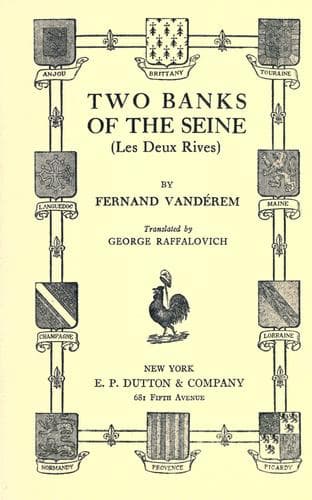
Two banks of the Seine (Les Deux Rives)Vandérem, Fernand
General
Two banks of the Seine (Les Deux Rives)
Vandérem, Fernand
Paris (France) -- Social life and customs -- 19th century -- Fiction
The night was cooler. On the distant plain, trains passed at intervals,
winding their coils of yellow lights on the horizon. Some roosters in
the neighborhood, deceived by the false paleness of the sky, sent to
each other, through space, their dauntless greetings, to which dogs
howled in reply.
M. Raindal gravely contemplated the blue stars. Each was to him a sun
with satellites gravitating round it. He asked himself how many sorrows,
identical with his own, must be making men moan at that same moment, on
those obscure planets. He reasoned, made calculations, intoxicating
himself with lofty thoughts. He invoked Human Sorrow, the Sufferings of
the Worlds, the Universal Complaint--the conventional pity, the
lip-charity, the egotistic and hypocritically tender hygiene, all the
declamatory remedies which books teach to alleviate personal sorrows.
But he derived no solace from them.
Poor thinker, poor master, poor Man! Yes, he could indeed call to his
help the spectacle of the heavens, the astronomers and the philosophers;
he could call on Newton, Laplace, Kant and Hegel! He could swell himself
up and make himself feel greater!
The fact remained that he still harbored within his own breast an atom
of flesh which was more sensitive and real than all those vaunted
infinites which were powerless alike to cure him and to dominate him.
What was there left to him in this overwhelming catastrophe? His family?
He had, in the last year, lost even the desire to cherish them. His
work? He hated the results of it, its lying mirage, its evil routine.
He closed the window, renouncing the stars. He sat on his bed once more
and began to cry.
Ended were his illusions! Gone his old man's fatuity! He would leave the
next day. He would not be a witness of _their_ humiliating amours. Never
again would he see his dear little pupil. And he wept.... It was at last
a sincere sorrow, without evil spite, without any parody of vanity, a
humble sorrow which acknowledged itself and loved its tears! In this M.
Raindal found peace and finally sleep.
On the morrow, however, when he went down to the garden about ten
o'clock, a sudden commotion reopened his secret wound.
"Yes, monsieur, madame has gone out," Firmin assured him. "She has gone
out for a drive with M. de Meuze."
"Which one?" M. Raindal almost shouted.
"With M. le Marquis.... M. le Comte and monsieur are still in their
rooms."
"Ah! very good!" M. Raindal said, recovering his ease.
He sat in a rocking-chair, in the shadow of the terrace and affected to
be engrossed in reading the paper.
But his set eyes were not on the lines. An internal passion was
following other ideas, other words, the little parting speech, a few
mysterious and firm sentences in which he would announce his intention
to leave. He had mastered the greater part of it when the close-cut mane
of Notpou emerged from between the trees.
Public-domain text, read in full here on John Shaqi.
Reviews
Reviews
No reviews yet
Be the first to share your thoughts on this work.
Elsewhere in the archive
Join the Discussion
Join the discussion
Sign in to leave a comment or review.
Sign InorCreate an account