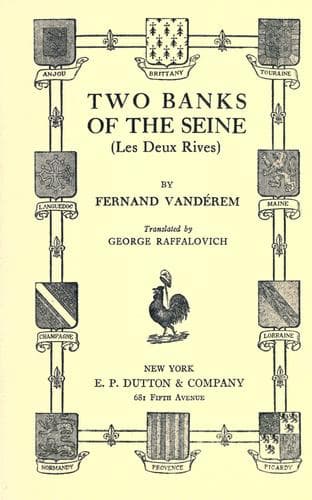
Two banks of the Seine (Les Deux Rives)Vandérem, Fernand
General
Two banks of the Seine (Les Deux Rives)
Vandérem, Fernand
Paris (France) -- Social life and customs -- 19th century -- Fiction
His head was oval yet chubby, all flesh, as it were, but for a crown of
brown hair around his baldness. M. Raindal thought he had a good-natured
smile. Gradually the master thawed out. He imparted to the abbé some
picturesque details concerning the Thebaid which, from professional
instinct, he had explored. The priest listened studiously, showed him
deference and solemnly nodded from the back of his head. Zozé took
advantage of a pause to ask:
"You will stay for dinner, M. l'abbé?"
"Well, yes, madame," he replied without hesitation, his round cheeks
distended in a cordial smile. "Yes, surely, if you will have me!"
"And you, dear master?" Zozé pursued. "Will you join the party?"
"Oh, it is impossible, dear lady," M. Raindal sighed. "I am expected....
Believe me, I am very sorry...."
He ceased abruptly as Chambannes entered, wearily caressing his thick
hinge-like mustache. Everyone stood up. He shook hands with M. Raindal
and asked, patting Zozé's neck, as one might do to a school-girl:
"Well, how did the lesson go, my dear sir?... Are you satisfied with
your pupil?"
"Very much gratified, monsieur ... an excellent beginning."
"Oh, we have not accomplished very much!" Zozé said. "But you are coming
next Thursday!... Thursday, I shall forbid the door.... I shall be at
home to no one.... You promise to come, don't you, dear master?"
M. Raindal promised. Zozé and Germaine went with him into the
drawing-room and the latter left with him. They shook hands as they
parted, Mme. de Marquesse pulling his arm so sharply that he felt a
cramp in the shoulder. He looked at his watch under a lamp-post. It was
a quarter to seven.
"Sapristi!" he murmured, horrified.
And once more he hailed a cab.
* * * * *
The boldness of fear moved him to anticipate irony or unwelcome queries
by an affectation of jovial talkativeness.
In a light vein, he told of his visit as if it had been a séance at the
Institute or a lecture at the Collège de France. He multiplied the
details, described the dresses and even gave an imitation of the abbé's
southern accent.
Thérèse affected to be interested and replied with good humor; she
seemed to have forgotten the morning's quarrel.
Mme. Raindal was silent. Why should she protest? Why should she wish to
dissuade her husband from this fatal intercourse with people devoid of
religion? Did she not know that he was irrevocably damned, marked
beforehand, because of his own atheism, for eternal torments? She
remembered, moreover, the master's anger at the occasion of the
Chambannes' dinner party: it was still alive in her mind and closed her
mouth with wise caution.
She only allowed herself a frown when M. Raindal gave a parody of the
abbé; her pained expression made Thérèse laugh so much that her father
began to have his suspicions concerning her good-natured remarks.
Public-domain text, read in full here on John Shaqi.
Reviews
Reviews
No reviews yet
Be the first to share your thoughts on this work.
Elsewhere in the archive
Join the Discussion
Join the discussion
Sign in to leave a comment or review.
Sign InorCreate an account