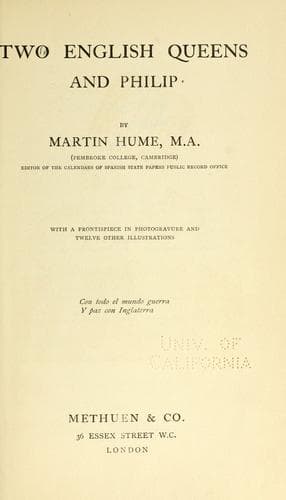
Two English queens and PhilipHume, Martin A. S. (Martin Andrew Sharp)
Philosophy
Two English queens and Philip
Hume, Martin A. S. (Martin Andrew Sharp)
Feria arrived in London on the 26th January, 1558, and to his surprise he
found the people and the Queen quite changed in temper since he had left
them with the King six months before. There was no despondency anywhere
now; for though the blow had been a shrewd one it had aroused the spirit
of the nation. The Queen was like a lioness; for she was fighting now, as
she thought, poor soul, for the inheritance of her unborn offspring; and
she threatened to have the head of any Councillor of hers who dared to
talk of peace with France until she had recovered the towns her ancestors
had held for centuries. She would win them again, she said; her son would
be born, and she and Philip, triumphant and at peace, would live happily.
It was a dream, but it was shared, so far as concerned the recovery of
the English territory in France, by the nation at large, which was now
on its mettle; and clergy, gentry, and merchants opened their coffers,
melted their gold chains, and mortgaged their belongings to provide funds
for avenging English honour and protecting the English soil against the
foreigner.
The moment the news of the peril of Calais had reached Mary she
despatched the Earl of Sussex and her Controller, Sir R. Rochester, to
assure Philip that she would send the forces to defend or recover Calais
without loss of time. When both Calais and Guisnes had been surrendered,
however, it seemed better to Philip to curb somewhat the Queen’s ardour
in the matter. It was too early in the year for him to begin his regular
campaign, and it was obvious that without his powerful co-operation the
English troops alone would be unable to recapture the lost fortresses. So
the first letter written by the King to Feria after the arrival of the
latter in England was couched in the cool, prudent tone so characteristic
of him. The ambassador was to thank the Queen heartily for her goodwill
to send him the troops, even after Calais had been lost, but as his own
territories were not in present danger, “I do not wish the Queen to begin
yet to incur expense, especially as we shall have to spend a great deal
later in attempting to recover the ancient English territory. You will
therefore tell the Queen how highly I appreciate her affectionate regard
for my interests; but as I have now sufficient forces to hold my own I
hope she will countermand the sending of troops, and apply the money to
defending the English coast, which is of the greatest importance.”[118]
Public-domain text, read in full here on John Shaqi.
Reviews
Reviews
No reviews yet
Be the first to share your thoughts on this work.
Elsewhere in the archive
Join the Discussion
Join the discussion
Sign in to leave a comment or review.
Sign InorCreate an account