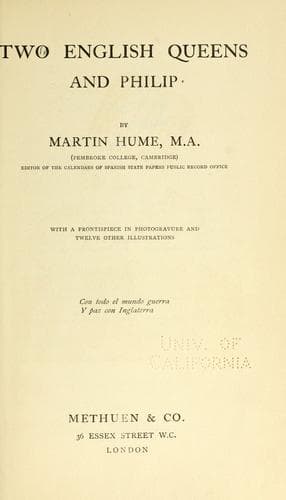
Two English queens and PhilipHume, Martin A. S. (Martin Andrew Sharp)
Philosophy
Two English queens and Philip
Hume, Martin A. S. (Martin Andrew Sharp)
So far from doing this, indeed, news came early in July that Dunkirk, one
of the most useful of his ports, within a few miles of Calais, had been
captured by the French, as well as Thionville, an important fortress.
Mary was panic-stricken at the news, and summoned Feria from Durham House
to say that she must at once send off a courier to Philip to know the
truth. Feria made light of the news, and said it was not worth while
to send in such haste, and the overburdened Queen broke out in angry
reproaches at his indifference. How could her merchants send their wool
to Flanders, she asked, if Dunkirk was in French hands? and yet Feria
treated the matter as of no importance. But when the ambassador suggested
that the English fleets in Plymouth and Dover should at once sail to
Dunkirk to help the King, Mary eagerly assented, though the Council at
once vetoed it; for, said they, the French have also captured Alderney,
and it behoved the admiral to go there first. “And really, to tell your
Majesty the truth,” wrote Feria, “I did not dare to contradict them,
for I saw that if but four French ships were to land their companies in
England they would overturn everything.” This was written in July, and
shortly afterwards Feria, having hectored the English Queen and Council
thus into placing the English fleet almost entirely at Philip’s disposal,
and having raised and paid three thousand German mercenaries which he had
appropriated, took his leave and returned to Flanders, first visiting
Elizabeth at Hatfield, much, he says, to her and his pleasure: “for
reasons which I will tell your Majesty when I see you.”
Mary now was a mere shadow. The cruel persecutions and the loss of Calais
together had completely destroyed the belief of the people in her power
to rule England for its own benefit. Her father and grandfather, and
even the greatly inferior Northumberland, had managed to maintain the
balance of power between the two great Continental rivals upon which
the importance of England depended. Mary from the first day of her
accession, as we have seen, had neglected this essential point in English
policy, and had ended by becoming a mere satellite of the Spanish
King, involving her country thus in a ruinous war, in which it had lost
much and had nothing to gain. The Council, against which Feria raged so
savagely, was, it is true, after the death of Gardiner, composed of men
of no commanding ability; but it had done its best to prevent the utter
subjection of England to Philip’s aims. The success of its efforts was
not great; for as Feria’s correspondence shows the most active members
of the Council were bought body and soul by Spain, and Mary was in
most cases ready to back up Feria’s arrogant hectoring with her royal
authority. For her, in her forlorn condition, the first consideration
was to please her husband and prevent the Catholic power, upon which she
increasingly depended, from collapse.
Public-domain text, read in full here on John Shaqi.
Reviews
Reviews
No reviews yet
Be the first to share your thoughts on this work.
Elsewhere in the archive
Join the Discussion
Join the discussion
Sign in to leave a comment or review.
Sign InorCreate an account