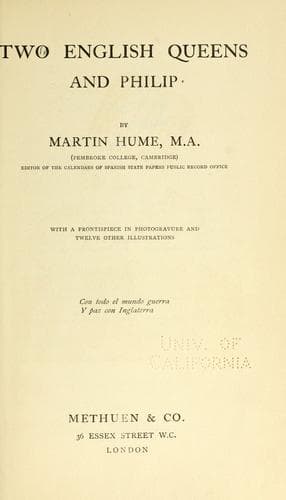
Two English queens and PhilipHume, Martin A. S. (Martin Andrew Sharp)
Philosophy
Two English queens and Philip
Hume, Martin A. S. (Martin Andrew Sharp)
The Queen was only partially conscious and unable to read Philip’s letter
when Feria came to bring her a message from her husband, and he lost no
time in travelling to Hatfield on his principal mission. Elizabeth had
been so wary and diplomatic in her difficult circumstances that she was
as yet an unknown quantity; and doubtless the crafty men of the world who
proposed to win her for Spain anticipated no great difficulty from this
reticent young woman of five-and-twenty, who had accepted Catholicism
so readily. The country was profoundly divided, and it was thought that
the new Queen—as Dassonleville wrote, in good faith—would be unable to
establish her authority without help from abroad. It was therefore, on
the face of it, not an extravagant presumption that she might prefer to
follow her sister’s lead and adhere to the traditional policy of England
in allying herself with the sovereign of Spain and Flanders.
When Feria arrived at Hatfield he received his first surprise. Before
starting from London he had summoned the Council, and in Philip’s name
had approved of Elizabeth as the heir to the Crown. Believing that this
would enable him to claim Elizabeth’s thanks, he began at Hatfield to
enlarge upon the service Philip had done her in thus securing to her
the succession. So long as high-flown compliment had been the staple of
conversation Elizabeth had given Feria as good as he had brought; but
the moment he bespoke her gratitude she stopped him, and said that she
would owe her Crown to no one but her people; and when he broadly hinted
at the advantage to her of a marriage with her Spanish brother-in-law or
a nominee of his she evaded the suggestion dexterously.[135] All through
the interview she showed a determination to resist any attempts to place
her in the tutelage of Philip. She answered Feria, indeed, somewhat
tartly at one point, that her sister had lost her people’s love by
marrying a foreigner; and the ambassador left her already convinced that
she would be no docile instrument in his master’s hands, as her sister
had been.
Public-domain text, read in full here on John Shaqi.
Reviews
Reviews
No reviews yet
Be the first to share your thoughts on this work.
Elsewhere in the archive
Join the Discussion
Join the discussion
Sign in to leave a comment or review.
Sign InorCreate an account