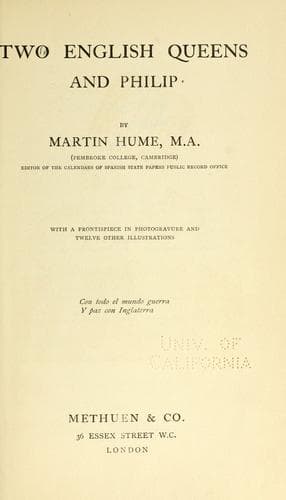
Two English queens and PhilipHume, Martin A. S. (Martin Andrew Sharp)
Philosophy
Two English queens and Philip
Hume, Martin A. S. (Martin Andrew Sharp)
Mary and Pole lay dying at the same time, fortified by the rites of
their Church, whose services were celebrated ceaselessly before their
weary eyes. With the Queen there were few now to do her reverence,
for most of her courtiers and Councillors were flocking to Hatfield
to worship the rising sun; but Mrs. Clarencius, the Countess of Feria
(Jane Dormer, Mary’s favourite maid of honour), and a few other faithful
friends stood by her to the last. On the morning of the 16th November
the Council assembled in her room, and Cordell, the Master of the Rolls,
read aloud the Queen’s will, although Mary was unconscious at the time.
Feria asserts that when the reader reached the bequests to her personal
attendants the Council desired him to omit that portion. In any case,
little attention was afterwards paid to the Queen’s testament, for there
were none who loved or mourned the forlorn woman. Before dawn on the
17th November Mass was celebrated in the dying chamber in the Palace of
St. James. Like her mother on her death-bed in similar circumstances,
Mary followed the sacred office devoutly, in the full possession now
of her faculties, making the responses audibly and fervently. When the
celebrant appealed to “the Lamb of God who took upon Himself the sins of
the world,” Mary answered clearly “_Miserere nobis, Miserere nobis, Dona
nobis pacem_.”[136] These cries for mercy, for mercy and peace, were the
last words of unhappy Mary Tudor. A few moments afterwards, as the priest
held up before her the Sacramental Host, her eyes flushed with tears, and
then closed for ever. Philip had no longer any footing in England. He
must win one again by force or favour, unless Spain was to surrender her
proud supremacy and Catholicism cease to rule the world.
CHAPTER V
1558-1565
Accession of Elizabeth—The beginning of the long duel—Feria
urges Philip to use force—Philip’s many difficulties—He offers
his hand to Elizabeth—The Peace of Cateau Cambresis—The
Franco-Spanish Alliance—Fears of a Catholic League—Philip
marries a French Princess—English Catholics appeal to
Philip—Mary Stuart claims the Crown of England—War with
Scotland—Philip’s efforts to effect a reconciliation—Bishop
Quadra—His relations with Leicester—Intrigue for a Catholic
reaction in England—Mary Stuart approaches Philip—Disgrace
and death of Quadra—A war of tariffs—Guzman de Silva,
ambassador—The interviews of Bayonne—Failure of the Catholic
League
Public-domain text, read in full here on John Shaqi.
Reviews
Reviews
No reviews yet
Be the first to share your thoughts on this work.
Elsewhere in the archive
Join the Discussion
Join the discussion
Sign in to leave a comment or review.
Sign InorCreate an account