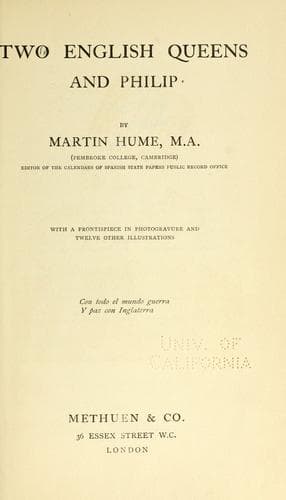
Two English queens and PhilipHume, Martin A. S. (Martin Andrew Sharp)
Philosophy
Two English queens and Philip
Hume, Martin A. S. (Martin Andrew Sharp)
The accession also of young Francis II. and Mary Stuart to the throne of
France, under the dominion of their ambitious Guise uncles, had driven
a great wedge into the unity of the Catholic League. The Guises, who
led the Catholic party in France, were now for a short time masters, on
behalf of the young King and his wife, of the national resources, and
were prepared to use them in furthering their Scottish niece’s claims
to the English throne. This naturally drew Philip more to the side of
Elizabeth, however perverse she might be, and, from the very first,
rendered abortive the Catholic League secretly cemented by the treaty of
Cateau Cambresis. When the death of Francis II., after his short reign,
threw the Guises into the background and made Catharine de Medici Regent
of France, matters were hardly improved. Philip was always a bad hand at
playing another’s game, and though his young French wife lived happily
with him, for he was a good husband, the purpose of her going to Spain
was never achieved, and Philip was as anxious after his French marriage
as before it to prevent his mother-in-law and his English sister-in-law
from making common cause against him. They, knowing this as well as he,
could, and did, always checkmate or paralyse him when they pleased by
simulating friendship with each other, either by marriage talk or by a
pretence of common interest. Whilst Catharine de Medici lived this was
the problem of Europe, and to Philip it proved an insoluble one.
Feria and Alba were for ever advocating the high hand with Elizabeth, but
Philip knew that his hollow union with France had drawn all Protestants
together, so that if he aided the English Catholics to depose Elizabeth
and crush Protestantism in her country, not only would Catholic France
be against him, but the Lutheran Germans would be disturbed, and perhaps
he might let loose the storm, of which the mutterings were already
audible, over his own Netherlands. So, in spite of the Bishop of Aquila’s
soft hints and Feria’s warlike advice, Philip decided, notwithstanding
Elizabeth’s religious recalcitrancy, upon a policy of palliation and
suavity in England. “You must,” he instructed his ambassador, “keep
mainly in view by all means to avoid a rupture. I have already pointed
out the importance of this, but it is so great that I cannot be satisfied
without repeating it many times.” But yet he was ready even thus early
if Elizabeth’s subjects attacked her for her religious measures to take
full advantage of the opportunity for his own advantage, and so to
prevent the French from establishing themselves in England. With these
pacific instructions, therefore, he sent the great sum of 60,000 crowns
“to gain friends,” and says, “I have also ordered, in case of need, that
money shall be raised to fit out a fleet at short notice, so that it may
be ready to carry men over to England if required.”
Public-domain text, read in full here on John Shaqi.
Reviews
Reviews
No reviews yet
Be the first to share your thoughts on this work.
Elsewhere in the archive
Join the Discussion
Join the discussion
Sign in to leave a comment or review.
Sign InorCreate an account