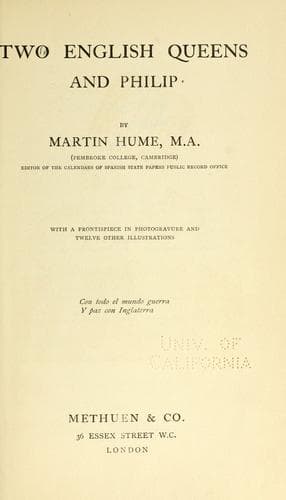
Two English queens and PhilipHume, Martin A. S. (Martin Andrew Sharp)
Philosophy
Two English queens and Philip
Hume, Martin A. S. (Martin Andrew Sharp)
Before crossing the Channel, de Spes had a conference with the Duke
of Alba at Utrecht, where a long list of Philip’s grievances against
Elizabeth were discussed. The indictment was a grave one, the injuries
said to be inflicted by the English upon Spaniards and Flemings amounting
in value, it was computed, to 300,000 ducats a year; and it is certain
that at this interview between the two fiery Spaniards plans for
revenging and amending this state of things were canvassed and agreed
upon. In England at the time there resided a Spanish merchant, ambitious
to fill a diplomatic _rôle_, and, although he had lived in London for
thirty years at least, he was as zealous and intolerant in religious
affairs as de Spes, or even Philip himself. This man, of whom we shall
hear much presently, Antonio de Guaras, anxious to ingratiate himself,
had sent to de Spes in Flanders two broadsheets that had just been
published in England attacking Philip’s system and the communications
that it was known passed between the English Catholics and the King of
Spain. Such papers, of course, had been published in Guzman’s time, but
he had wisely passed them by or minimised their importance. To de Spes
they served as a spark to the tinder of his passion, and he arrived in
England fuming with rage at the insolence of the heretics.
As de Spes rode from Dover towards London, with a long train of Spanish
residents in England at his heels, early in September, 1568, he was
overtaken by a Scottish gentleman (probably James Beton) on his way
from Paris in the service of the imprisoned Mary, with whom he was
going to seek an interview. De Spes listened eagerly to his story of
the ill-treatment of Mary by the “heretics,” and told him that he had
letters in London from King Philip to her. He had enough prudence to
tell the Scot when, after their arrival in the capital, he came for the
King’s letter to take to Mary that it would be wise that he, as Spanish
ambassador, should not be seen too prominently in her interests; but he
associated himself at once in all the Scottish Queen’s plans to escape
from her bondage, and sent her warm messages of encouragement. Almost
at the same time (15th September) Philip himself was writing from the
Escorial an important letter to the Duke of Alba. The Queen of Scots, he
said, had written praying for his help to extricate her from Elizabeth’s
hands, and professing her readiness to die in defence of the faith.[175]
“I have refrained from arriving at any decision or answering her
autograph letter ... until you tell me what you think of the business,
and in what way and to what extent I should assist her. I beg you to
write to me by the first opportunity on the matter, and in the meanwhile
to encourage the Queen the best you can to persevere firmly in her
saintly purpose; for whilst she does so God will not abandon her.”[176]
It is obvious from this that Philip had not decided yet to help Mary,
Public-domain text, read in full here on John Shaqi.
Reviews
Reviews
No reviews yet
Be the first to share your thoughts on this work.
Elsewhere in the archive
Join the Discussion
Join the discussion
Sign in to leave a comment or review.
Sign InorCreate an account