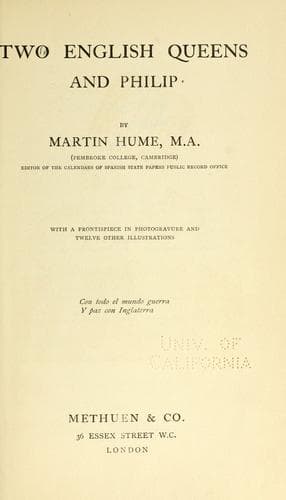
Two English queens and PhilipHume, Martin A. S. (Martin Andrew Sharp)
Philosophy
Two English queens and Philip
Hume, Martin A. S. (Martin Andrew Sharp)
When Wynter received Spinola’s news on the 2nd December he was in
Plymouth, assuring himself of the safety of the Spanish treasure ships
there. Wynter naturally told the evil news he had learned from Spinola
to William Hawkins, the brother of John, who lived in Plymouth, and
William at once wrote to Cecil, who was also interested in the venture,
suggesting that Spinola should be questioned, and if it turned out that
the Spaniards had attacked the English trading expedition, the money
in the ships now being protected by English guns should be seized in
reprisal. This letter was written on the 3rd December, the day after
the safe conduct had been signed by Elizabeth for bringing the treasure
overland to Dover, and before Cecil can have received it this safe
conduct was on its way in the hands of de Spes’s agents to Southampton,
and so to Plymouth and Falmouth. Cecil’s messengers, however, were not
far behind, and, in spite of the protest of the Spanish captain, Horsey,
the Governor of the Isle of Wight, by Cecil’s secret orders, landed the
treasure from the ship at Southampton and placed it in the keeping of the
mayor of the town. Similar action was taken with the treasure at Plymouth
and Falmouth, and when the news reached de Spes in London he at once
jumped at the conclusion that the rumours were true that he had heard at
Court to the effect that some of the Queen’s Council and her Huguenot
friends had been urging her to keep the treasure for her own purposes.
Spinola, a resident in London, dependent largely upon Elizabeth’s
goodwill and Cecil’s friendship, had, indeed, let out in conversation
not only what he had heard about the Spanish attack upon John Hawkins’s
expedition in Mexico, but also that the Genoese financiers were
responsible for the money advanced to Philip until it was handed to the
Spanish authorities in Flanders. “In that case,” said Elizabeth, “I can
borrow it myself; for my credit is quite as good as that of the King of
Spain.” Rash de Spes, however, did not wait for any such public avowal.
To his intemperate and insolent protests Cecil and the other Councillors
would only say that the money was quite safe, and for the present no
other answer with regard to it could be given to him. This was on the
21st December and the ambassador at once sent a special courier to Alba
with a letter praying, in burning indignation, that all English property
and that of Spinola on Spanish soil should be seized.[179] Nothing more
unwise than this can be conceived; for no sooner had Alba made the
confiscatory proclamation than Elizabeth not only justified thereby her
seizure of the money, now openly avowed, but at once confiscated all
Spanish and Flemish property in England, including the ships that had
brought the money.
Public-domain text, read in full here on John Shaqi.
Reviews
Reviews
No reviews yet
Be the first to share your thoughts on this work.
Elsewhere in the archive
Join the Discussion
Join the discussion
Sign in to leave a comment or review.
Sign InorCreate an account