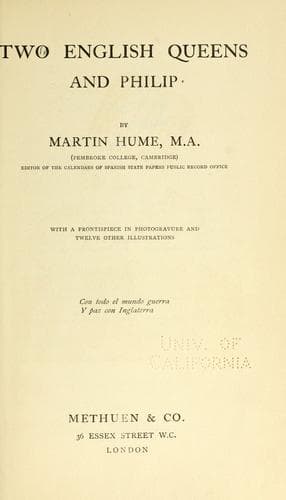
Two English queens and PhilipHume, Martin A. S. (Martin Andrew Sharp)
Philosophy
Two English queens and Philip
Hume, Martin A. S. (Martin Andrew Sharp)
It is clear that notwithstanding de Spes’s constant predictions of
immediate coming success, and his repeated assurances that Elizabeth
and her friends would be swept aside as a consequence of this plan,
Philip was never greatly deceived by it. Alba had told him that he was
powerless for the present, and he knew England sufficiently well to see
that unless a large and well-organised force was used at the critical
moment by him, an attempt to revolutionise England in his interests would
fail. The trail of deadly deliberation, moreover, palsied every act
of his life. At some time in August, 1569, when Mary Stuart’s appeals
were reaching him, he instructed Alba to obtain full particulars of the
military possibilities of the situation in England, in order that any
action he might decide to take later should be effectual. A half-dozen
or more envoys of various sorts, official and unofficial, had been
sent over one after the other to try by some means to effect a mutual
restitution of the seizures—Genoese financiers, Flemish diplomatists,
and even Protestant merchants—but all without effect. On receiving the
King’s orders, however, Alba instructed another embassy, surely the
strangest for such a purpose ever seen, to go to England and endeavour
to make terms with Elizabeth or bribe her advisers. The leader was
one of Alba’s most trusted Italian generals, Ciappino Vitelli, and he
was to be accompanied by fifty experienced military officers, with
a couple of official secretaries for appearance’ sake. That their
mission was not that which ostensibly appeared is clear from the fact
that at the same time Alba sent another unofficial envoy—the Genoese
merchant mariner Fiesco—to attempt to gain a restitution by the private
bribery of Leicester and Cecil. Cecil and the Queen laughed at the
idea of such an embassy as that of this fire-eating Ciappino coming
to settle a commercial dispute, and when the party arrived at Calais
for embarkation for England, Cobham, the Governor of Dover Castle,
sent word that only Ciappino Vitelli himself and a small suite would
be received. A still smaller number was allowed to proceed beyond
Dover, and another detachment was stayed at Canterbury; so that by the
time the gouty, obese, old Italian general was received by the Queen
at Kingston-on-Thames, not even de Spes being allowed to accompany
him to the presence, the military object of the mission was cleverly
frustrated. The plague was raging in London, and Ciappino never entered
the capital; and his interview with the Queen was mainly taken up by her
angry complaint of the insolence of the Duke of Alba. After many days
of quibbling, he was told that his powers were insufficient, and was
politely invited to get out of the country as quickly as possible, his
despatches to Alba being intercepted and read at Dover.
Public-domain text, read in full here on John Shaqi.
Reviews
Reviews
No reviews yet
Be the first to share your thoughts on this work.
Elsewhere in the archive
Join the Discussion
Join the discussion
Sign in to leave a comment or review.
Sign InorCreate an account