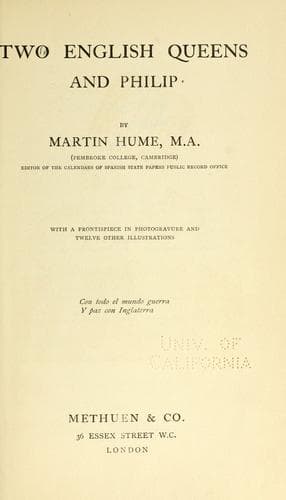
Two English queens and PhilipHume, Martin A. S. (Martin Andrew Sharp)
Philosophy
Two English queens and Philip
Hume, Martin A. S. (Martin Andrew Sharp)
It was indeed time that so dangerous a guest should be promptly asked
to depart; for this was the most critical juncture of Elizabeth’s reign
and her Crown trembled in the balance. All the lords were not so
pusillanimous as Norfolk. Both Dacre and Northumberland had formally
notified to de Spes that they were ready to take up arms in Philip’s
service. For many months the imprudent ambassador had been going beyond
his instructions and encouraging these nobles to expect effective aid
from Philip. If only a small number of arquebusiers were sent to them
from Flanders, said Northumberland and Westmorland, they would undertake
to release Mary, subdue the North of England, restore Catholic worship,
and make friends with Spain. “I feel sure,” wrote de Spes, “that they
will attempt the task; and it will be better effected by them than by the
Duke of Norfolk, as they are better fitted for it, and the Queen of Scots
will have greater freedom in the choice of a husband.”
The questionable attitude of Westmorland and Northumberland caused
Elizabeth to summon them to her presence. They disobeyed and, raising
their standard, marched into Durham in force on the 14th November.
Destroying the communion table in the cathedral, they caused Mass to
be solemnly celebrated; and then pushing rapidly onward towards Ripon,
Wetherby and Tadcaster, they finally assembled on Clifford Moor. The Earl
of Sussex, the Queen’s Lieutenant in York, was for a time reduced to act
on the defensive; and now, if Alba had been prompt and Philip ready, it
is possible that the die might have been cast a winning number; and Mary
Stuart, rescued from Tutbury, whither she had been rapidly carried, might
have been made Queen of a Catholic Britain, under Spanish protection.
When news came to de Spes of the southward march of the lords and their
renewed prayers for aid from Flanders, he wrote to the King: “I have
on several occasions written to your Majesty of the goodwill of these
nobles, and I have given a letter in cipher to the gentleman they are
sending to the Duke of Alba to ask for aid. They beg for prompt reply,
as communications will soon be stopped.... It is certain that there has
never been so good an opportunity either of punishing those who have so
grievously opposed your Majesty’s interests, or of restoring the Catholic
religion, in which consists the maintenance of our old alliance and
friendship with this country.” To Alba de Spes wrote in jubilant strain
on the 1st December. “The rebels,” he said, “were twelve thousand strong
and were marching to release Mary and give battle to the Queen’s forces;”
but he ominously adds that none of their confederates have yet risen.
Ciappino Vitelli was still lingering at Colebrook, near Windsor, on the
pretext of gout, though messages were being sent to him from the Queen
that she considered his continued stay in England highly suspicious, as
indeed it was, considering that he told de Spes, who doubtless conveyed
Public-domain text, read in full here on John Shaqi.
Reviews
Reviews
No reviews yet
Be the first to share your thoughts on this work.
Elsewhere in the archive
Join the Discussion
Join the discussion
Sign in to leave a comment or review.
Sign InorCreate an account