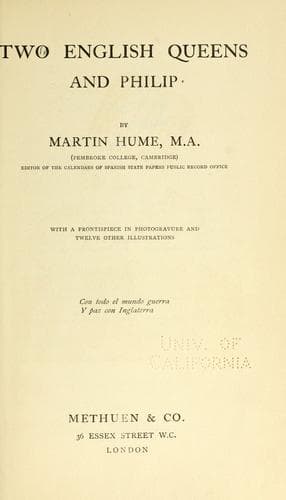
Two English queens and PhilipHume, Martin A. S. (Martin Andrew Sharp)
Philosophy
Two English queens and Philip
Hume, Martin A. S. (Martin Andrew Sharp)
For some time the authorities could get no further than this. Of course
they knew that the two persons unnamed were Mary and Norfolk, but they
needed legal proof, and gradually Cecil’s net was widened and swept into
gaol one after the other of the confidants and tools of the plotters.
In August a false follower of Norfolk brought to the Council a bag of
£600 with a cipher letter that had been entrusted to him by Norfolk’s
secretary to forward to Lord Herries, the leader of Mary’s Catholic
friends in Scotland. Curiously enough this sum of money had been received
from the French ambassador, so it is clear that Mary and Norfolk were
playing false and doing what Alba dreaded most, namely, bringing the
French into the business. But this fact made matters no better from
the point of view of the English Council, and suddenly the Duke of
Norfolk, the first noble in England, found himself in prison with all
his confidential servants. The torture did its fell work promptly, and
the secrets of the underlings were drawn from them, implicating the Duke
beyond redemption. The Bishop of Ross, seeing his most secret papers
deciphered, became almost loquacious in his fright, and went out of his
way to vituperate his unhappy mistress.
Norfolk collapsed as abjectly as before. He had hoped at first, he said,
to wed Mary by Elizabeth’s permission. He was sorry and repentant for
having acted so falsely after he had promised not to do so, and would
never do it again. He had not really been a Catholic, he said, and now
submitted himself entirely to her Majesty’s mercy. He had never, he
solemnly avowed, intended to bring foreign troops into England, or to
touch the sacred person of his revered sovereign. It was all the fault
of the Bishop of Ross, of Mary, of anybody but himself, ... and so, with
such sorry lies as this, the most beloved and highest noble in England
whined for mercy and his bare life. Elizabeth was loath to sacrifice him,
for he was her cousin and the head of a powerful group of Englishmen, but
at length the Protestant influences around her were too strong for her to
resist, and Norfolk’s head fell on Tower Hill on the 2nd June, 1572.
Public-domain text, read in full here on John Shaqi.
Reviews
Reviews
No reviews yet
Be the first to share your thoughts on this work.
Elsewhere in the archive
Join the Discussion
Join the discussion
Sign in to leave a comment or review.
Sign InorCreate an account