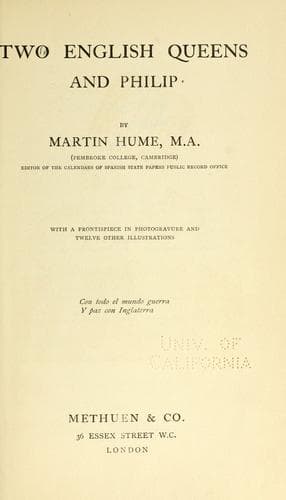
Two English queens and PhilipHume, Martin A. S. (Martin Andrew Sharp)
Philosophy
Two English queens and Philip
Hume, Martin A. S. (Martin Andrew Sharp)
As the damning facts were gradually wrung out of the miserable
accomplices in the plot, during the summer and autumn of 1571 the
position of de Spes became daily more impossible in England. His name
was constantly cropping up in the depositions, and every deponent had
some evidence to give of his activity in forwarding this conspiracy
to overturn the Government to which he was accredited. Even then,
semi-prisoner as he was, and himself in danger of punishment or
ignominious expulsion, he never ceased to plot; and his eagerness made
him and his master an easy prey to an amusing piece of successful
mystification that any person less blinded by hate than he would have
seen through at once. It will be recollected that John Hawkins’s trading
expedition to Central America had been treacherously attacked by a
superior Spanish force at St. Juan de Lua, Mexico, in October, 1568,
Hawkins with difficulty escaping with only two tiny ships. Property of
great value and over a hundred men had been captured by the Spaniards
and sent to Seville, the unfortunate sailors being delivered to the
Inquisition and condemned to slavery. John Hawkins was the last man in
the world to reconcile himself tamely to such a loss; and through a
Catholic friend of his, George Fitzwilliam, a kinsman of the Duchess of
Feria, he opened negotiations in Spain for the release of his sailors and
the return of his property, on condition that he deserted the English
service with the Queen’s fleet of fourteen armed ships, and joined that
of the King of Spain for the invasion of England in favour of Mary Stuart.
Poor Mary, as usual, was easily hoodwinked, as indeed was Fitzwilliam
himself at first, and the Ferias eagerly listened to the suggestion of
apostasy of such a man as John Hawkins. Fitzwilliam returned to London
from Spain with an encouraging answer and tokens for the Queen of Scots,
in order that she might be asked to assure the Ferias and Philip of the
genuineness of Hawkins’s offer. Cecil, who was behind Hawkins in the
whole negotiation and enjoyed the position almost as much as the great
sailor, smoothed over the difficulties of access to Mary, who, only
too ready to believe in the honesty of others, sent him back to Spain
with all sorts of assurances, letters for Philip and the Ferias, and a
beautiful missal bound in gold for the Duchess of Feria, wherein she
had written “_Absit nobis gloriari nisi in cruce Domini nostri Jesu
Christi.—Marie R._” When Fitzwilliam came to him, de Spes was easily
drawn into the plan, and became enthusiastically certain of the _bonâ
fides_ of Hawkins. The more he sees of him, he says, the more convinced
he is of his honesty. He is a Catholic, and very ambitious; and only
once, and then but for a moment, did the gullible ambassador somewhat
distrust Cecil’s complaisancy in allowing Fitzwilliam easy access to Mary
Stuart, and to run backwards and forwards unimpeded between England and
the coast of Spain.
Public-domain text, read in full here on John Shaqi.
Reviews
Reviews
No reviews yet
Be the first to share your thoughts on this work.
Elsewhere in the archive
Join the Discussion
Join the discussion
Sign in to leave a comment or review.
Sign InorCreate an account