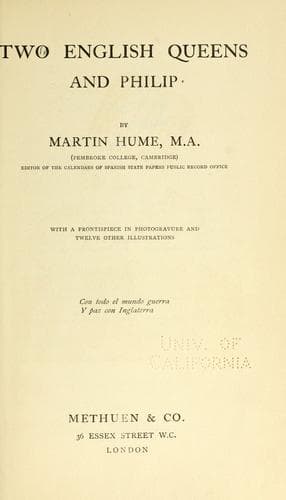
Two English queens and PhilipHume, Martin A. S. (Martin Andrew Sharp)
Philosophy
Two English queens and Philip
Hume, Martin A. S. (Martin Andrew Sharp)
Mendoza thought probably that he had gone too far, as he certainly had;
for Philip, as we shall see later, had no intention, or indeed ability,
at this time (October, 1581) to attempt the conquest of England. He did
not desire to threaten, Mendoza said; he was in her power and of course
she could do as she liked with him, but whatever she did, thank God!
King Philip would avenge him. Elizabeth then ordered every one out of
the room but the two Councillors, to whom in angry tones she repeated
Mendoza’s threat about cannon, and her reply. “I smiled to hear her
relate this with so much fury and agitation, and remarked that I would
not waste time on that point. Monarchs, I knew, were never afraid of
private individuals, and above all she, who was a lady so beautiful that
even lions would crouch before her. She is so vain and flighty that her
anger was at once soothed on hearing this, and she began to relate how
thankful your Majesty ought to be to her for having refused help to the
Flemish rebels. All she had done was to prevent the French from taking
possession of your territory.” Thenceforward to the end of the long
interview Elizabeth played off the Spanish support of the Irish rebels,
the subsidising of the northern rebellion, and the intrigues of de Spes,
against Mendoza’s complaints of her help to Orange, the depredations of
Drake, and the reception of Don Antonio; and the exchange of grievances
ended by Elizabeth coldly saying that she would receive the ambassador
no more until the King sent her some satisfaction, to which he retorted
by saying that he would prefer to do business with the Council. As he
turned to go and was already some paces from the Queen he heard her
heave a deep sigh, and say in Italian, evidently intended to reach his
ear, “I would to God that each one had his own and was at peace.”[235]
Mendoza, humiliated and embittered at the course of events, which he
ascribed entirely to Leicester and Hatton, thenceforward became a more
virulent enemy of Elizabeth than ever de Spes had been. In the next
letter after the interview just described he prayed Philip to avenge
himself by seizing all English property in his dominions; but the King
had tried that game before to his cost, and dared not run the risk again,
nor would he listen to Mendoza’s earnest prayers to anticipate the
intrigues of Leicester to have him expelled from England by recalling him
himself.
Public-domain text, read in full here on John Shaqi.
Reviews
Reviews
No reviews yet
Be the first to share your thoughts on this work.
Elsewhere in the archive
Join the Discussion
Join the discussion
Sign in to leave a comment or review.
Sign InorCreate an account