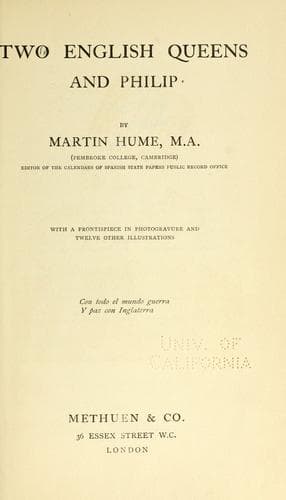
Two English queens and PhilipHume, Martin A. S. (Martin Andrew Sharp)
Philosophy
Two English queens and Philip
Hume, Martin A. S. (Martin Andrew Sharp)
When, therefore, Father Creighton returned, in October, 1581, from his
mission to Scotland, Mendoza was ripe for any plan which promised injury
to Elizabeth. The Jesuit told him how he had been secretly conveyed
across the Scottish border, and had conferred with Lennox, Eglinton,
Huntly, Caithness, and Seton, who had warmly consented to Catholic
missioners being sent—“on condition that they brought money for their
own maintenance.” They would have King James approached, too, and told
that his one hope of obtaining the English succession would be for him to
embrace Catholicism and make friends with Spain. Neither Lennox nor the
King was to be frightened with the suggestion that the French were to be
thrown over: but Seton, who appears to have known James’s character well,
proposed that his greed and ambition might be worked upon by his being
shown how much more effectual a friend Spain would be to him than France.
Father Parsons was in London when Creighton arrived, and he and his
colleague Heywood were long closeted with Mendoza to discuss who should
be the pioneer missioners to Scotland. Creighton thought that Father
Parsons, himself, and Heywood should go, “as they would need to be very
learned and virtuous men.” Parsons, still in his captain’s garb, ran over
to Rheims to consult the Principal of the English Seminary, Dr. Allen;
and at Mendoza’s instance it was agreed that Parsons could not well be
spared from England, and that Dr. Allen should appoint fresh men for the
Scottish mission.
The six English Catholic lords who had first arranged the matter with
Mendoza were now in prison: Catholics were being savagely persecuted
everywhere, and it was evident that the scheme for upsetting Elizabeth
by means of a Catholic movement in Scotland must be managed by Spanish
agents in France and Dr. Allen, “as the Queen and her heretics are served
here by such a multitude of spies that the Queen of Scots herself is in
great alarm.” But above all, says Mendoza, though the affair must be
managed in France, “the French must have no suspicion that your Majesty
has anything to do with it.” As may be supposed, Mary Stuart was a keen
participant in the scheme. In April, 1581, six months previously, she had
sent a message through Archbishop Beton to the new Spanish ambassador in
Paris, Tassis. “Things,” she said, “were never in better form in Scotland
than now for a return to ancient conditions, so that English affairs
could be dealt with afterwards from there. Her son was determined to
be a Catholic, and inclined to break with Elizabeth as soon as he could
be sure of substantial help.” This help Mary earnestly begged of Philip
through Tassis, and asked that it should be landed first in Ireland,
ready to cross to Scotland as soon as the treaty was signed.
Public-domain text, read in full here on John Shaqi.
Reviews
Reviews
No reviews yet
Be the first to share your thoughts on this work.
Elsewhere in the archive
Join the Discussion
Join the discussion
Sign in to leave a comment or review.
Sign InorCreate an account