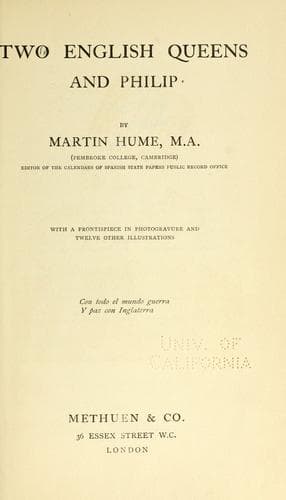
Two English queens and PhilipHume, Martin A. S. (Martin Andrew Sharp)
Philosophy
Two English queens and Philip
Hume, Martin A. S. (Martin Andrew Sharp)
Holt went back to Scotland with a promise from Mendoza, which he
certainly was not authorised by Philip to give, that the two thousand
men asked for should be sent to their aid, and the English Catholics, or
such of them as were still at liberty, were conciliated by means of Lord
Henry Howard, who was very heavily bribed by Philip, and thenceforward
became the principal Spanish agent at Elizabeth’s Court. The plot looked,
indeed, a promising one under the sole guidance of Mendoza; and all were
in high hopes that Mary Stuart’s fortune was at last to take a turn,
when Father Creighton arrived in Paris directed to Tassis, the Spanish
ambassador, with a letter from the Duke of Lennox. “Understanding,” he
says, “from the missioners that the Pope and the King of Spain desire to
make use of him for the design they have in hand to restore the Catholic
faith in Scotland and release the Queen ... he is prepared to employ
his life and estate in carrying out the same, on condition that he is
supplied with all things set forth in the statement taken by Father
Creighton.” This letter was dated early in March, 1582, and reached
Tassis in May, having been brought to him by Creighton and Parsons.[240]
The plan was a perfectly new one to Tassis, as Mendoza in London had been
the sole intermediary purposely chosen by Mary and the originators of the
plot, in order to exclude any probability of French participation; and
Philip, to his surprise, was now informed of the affair by his ambassador
in Paris, as if for the first time. Why Lennox should have chosen to send
his adhesion to Paris instead of to Mendoza is not quite clear; but,
being naturally attached to Guisan interests, it is probable that he
wished to ensure that his French patrons should not be excluded.
In any case, it does not need much knowledge of Philip’s character
to foresee that such inept management as this would upset the whole
business as far as he was concerned. The demands of Lennox, as stated
by Creighton, were ridiculous. The Scottish Lords had promised Mendoza
through Holt that if two thousand foreign troops landed they would be
able to effect the revolution, and this was a number that Philip could
have provided; but here was Lennox demanding twenty thousand men paid
for eighteen months and a large quantity of munitions of war of all
sorts. He must have, he says, twenty thousand crowns in money sent to
Scotland immediately for fortifications, &c., and a further subsidy to
raise Scottish troops; he asks that the troops should be of various
nationalities and placed under his command, and if the attempt failed and
he lost his Scottish estate in consequence, he wanted a guarantee from
the Pope and Philip that an estate of equal value should be given to him
elsewhere. He proposes himself to leave Scotland at the most critical
juncture, and to go to Paris to make final arrangements, as soon as he
hears that the Pope and the King of Spain are pledged to the enterprise.
Public-domain text, read in full here on John Shaqi.
Reviews
Reviews
No reviews yet
Be the first to share your thoughts on this work.
Elsewhere in the archive
Join the Discussion
Join the discussion
Sign in to leave a comment or review.
Sign InorCreate an account