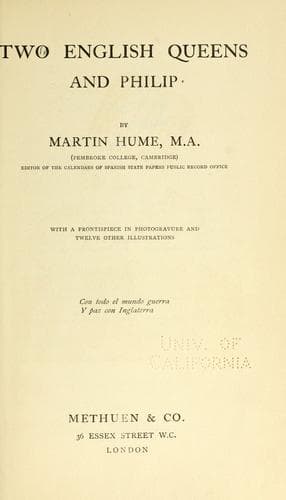
Two English queens and PhilipHume, Martin A. S. (Martin Andrew Sharp)
Philosophy
Two English queens and Philip
Hume, Martin A. S. (Martin Andrew Sharp)
In the middle of May, 1586, Charles Paget, who was still one of Mary’s
agents in Paris, came to Mendoza, bringing with him an English priest
named Ballard, who had been sent by a number of Catholics, especially
in Lancashire and the North, to represent to him that: “God had infused
more courage than ever into them, and had convinced them that no time
was so opportune as the present to shake off the oppression of the Queen
and the yoke of heresy that weighs upon them, as most of the strongest
heretics are now absent in Zeeland. They say that I have never deceived
them, and they beg me to tell them whether your Majesty had determined
to help them to take up arms when they decided to do so.”[268] Mendoza
had but a general expression of sympathy to reply to this; for though
the great fleet of conquest projected in Spain was already the talk of
Europe, to Philip’s officers it was still supposed to be an inviolate
secret. This inquiry of the English Catholics, however, was not John
Ballard’s real reason for coming to see Mendoza. He handed him a letter
from four English Catholics who had access to Elizabeth’s Court, in which
they promised to kill the Queen either by poison or by steel if they were
assured of Philip’s help after the deed was done. Mendoza ciphered the
letter himself and sent it to Philip’s secretary, but as John Ballard
did not broach the subject verbally Mendoza’s disinclination to give any
pledges kept Ballard in Paris beating about the bush in doubt for many
weeks. Parsons, who was a good hater, asserted ten years afterwards[269]
that the whole scheme of Ballard and Gifford was promoted by Paget
and Morgan, Mary Stuart’s correspondents in Paris, for the purpose of
frustrating the purely Spanish attack upon England, to which they are
represented as being bitterly hostile, and that Walsingham was informed
of the plot with the same object. Paget was, and continued to be, a
pensioner of Spain, and Morgan, who was entirely trusted by Mary, was
also richly rewarded by Philip, at her request; but there is no reason
to doubt the positive assertions of Parsons that both of them belonged
to the anti-Jesuit party, to which, indeed, most English as well as
the Scottish and Welsh Catholics adhered; and that by every means they
endeavoured to frustrate what Allen and the Jesuits tried so hard to
promote—a Spanish domination of England.
Public-domain text, read in full here on John Shaqi.
Reviews
Reviews
No reviews yet
Be the first to share your thoughts on this work.
Elsewhere in the archive
Join the Discussion
Join the discussion
Sign in to leave a comment or review.
Sign InorCreate an account