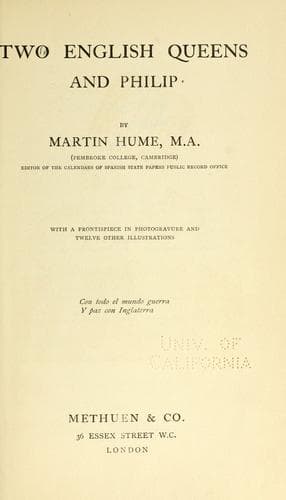
Two English queens and PhilipHume, Martin A. S. (Martin Andrew Sharp)
Philosophy
Two English queens and Philip
Hume, Martin A. S. (Martin Andrew Sharp)
Almost from Mary’s accession Cardinal Pole had been held back from his
mission by the action of the Emperor, thanks mainly to the complaisancy
of the new Pope Julius III. The great difficulty was the question of
the restitution of the Church property which had been confiscated in
the previous reigns. There were few noble courtly families in England
which had not indeed been enriched from this source; and the Emperor
expressed his opinion to Pole that the English people cared neither
for one form of faith or the other, so long as they could keep their
property.[73] “Pole,” said the Venetian ambassador at Brussels, “might
beg for permission to go to England for ten thousand years without avail,
unless he went with the briefs confirming the alienation of the Church
properties: for if the Church insists upon reclaiming them disorder will
prevail throughout the country.”
At last the Cardinal had to accept the inevitable, not without some
bitterness of heart,[74] and steps were taken in the Parliament, which
met at Westminster early in November, to reverse the act of attainder
against him. His coming was regarded in some sense by the country as
that of a restraining force upon the dreaded Spanish influence in the
English Councils. He was known to be single-minded in his attachment
both to the Church and to England. He was not ambitious, and had nothing
to gain by serving as a tool for anti-English forces, whilst his rank,
his ability, and his good repute promised that his authority would be
great, even if necessary, against the foreign King-Consort. On the 5th
November, 1554, a deputation was despatched by Mary, consisting of Lords
Paget and Hastings and Sir William Cecil, to invite Pole to England, not
ostensibly as Legate, but as Cardinal and ambassador, on condition that
the Pope would consent to the present owners of the ecclesiastical lands
being left unmolested. Renard had already been sent over to Flanders to
persuade Pole of the need for this proviso, and had returned successful.
The Cardinal was ready, and rejoiced greatly when Sir John Mason, the
English ambassador, told him the news; though, “Marry, quoth he, you know
I am at this present, as it were, in another’s ward [keeping].—I must
depart when it please the Emperor, who is not at all times to be spoken
withal. I have already one sent to M. d’Arras (_i.e._, Granvelle) to be
my mean to have access to his Majesty to take my leave.... Marry, the
truth is that they have had as yet no news out of England of the Queen’s
determination.”[75] Mason assured the Cardinal that it was all settled
and that the embassy named had been despatched to fetch him.
Public-domain text, read in full here on John Shaqi.
Reviews
Reviews
No reviews yet
Be the first to share your thoughts on this work.
Elsewhere in the archive
Join the Discussion
Join the discussion
Sign in to leave a comment or review.
Sign InorCreate an account