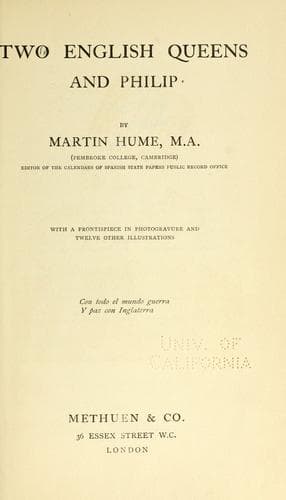
Two English queens and PhilipHume, Martin A. S. (Martin Andrew Sharp)
Philosophy
Two English queens and Philip
Hume, Martin A. S. (Martin Andrew Sharp)
In vain Philip urged moderation in the prosecution of heresy, and one
of his chaplains, Alfonso de Castro, publicly in an outspoken sermon
denounced the burning of heretics as opposed to the true spirit of
Christ. But Bonner and Gardiner pursued their stern way, and most of the
odium of their proceedings fell upon the King and his countrymen. The
Queen, herself in a fool’s paradise of hope and joy, thought of nothing
but the coming glory of maternity. The country itself was awaiting the
event as one that was to decide, so far as could be seen, its future
fate. Ominous mutterings of the fell bonfires that had already begun in
Smithfield were common enough, and the factions in the Eastern Counties
were as active as ever beneath the surface, notwithstanding their
ruthless suppression. The English exiles in France were being made much
of in the Court of Henry II., and loaded with favours, whilst Noailles
in London kept in close touch with the elements of discontent at home.
In the circumstances Philip’s intention to obey his father’s summons to
Flanders soon after the dissolution of Parliament had to be postponed, at
least until the expected confinement of the Queen in April had cleared
the air and settled men’s minds.
In the meanwhile Philip continued to do his best to maintain his
popularity, counselling prudence to the zealous bishops, lavishing
money on courtiers, interceding gently for Elizabeth and Courtenay, and
taking active part in the showy military exercises which the English
loved, but which for him had no attraction.[91] In March, Courtenay
from his prison at Fotheringham wrote to Philip, saying that, as by the
King’s intercession with the Queen so many persons had been released, he
prayed for his mediation in his favour, very submissively beseeching his
protection and that he would deign to accept his service. This happened
at the very time that the new conspiracy was discovered, but Courtenay
was almost as dangerous in an English prison as free, and, thanks to
Pole’s support of Philip’s efforts, and on the understanding that he
would accompany the English embassy to Flanders and Rome, Courtenay was
summoned to Court and graciously received by the Queen and her husband.
Public-domain text, read in full here on John Shaqi.
Reviews
Reviews
No reviews yet
Be the first to share your thoughts on this work.
Elsewhere in the archive
Join the Discussion
Join the discussion
Sign in to leave a comment or review.
Sign InorCreate an account