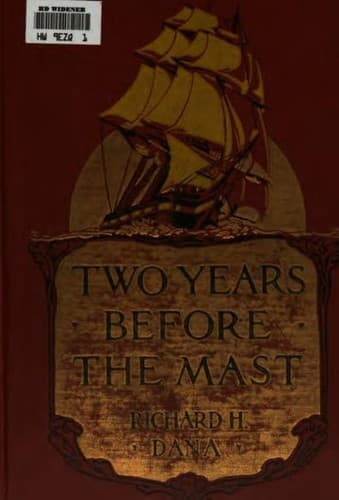
Dana, Richard Henry, 1815-1882; Sailors; Seafaring life; Voyages and travels
While we were standing about on deck, we saw the little brig
drifting by us, hove to under her fore topsail double reefed; and
she glided by like a phantom. Not a word was spoken, and we saw no
one on deck but the man at the wheel. Toward morning the captain
put his head out of the companion-way and told the second mate,
who commanded our watch, to look out for a change of wind, which
usually followed a calm, with heavy rain. It was well that he did;
for in a few minutes it fell dead calm, the vessel lost her
steerage-way, the rain ceased, we hauled up the trysail and
courses, squared the after-yards, and waited for the change, which
came in a few minutes, with a vengeance, from the northwest, the
opposite point of the compass. Owing to our precautions, we were
not taken aback, but ran before the wind with square yards. The
captain coming on deck, we braced up a little and stood back for
our anchorage. With the change of wind came a change of weather,
and in two hours the wind moderated into the light steady breeze,
which blows down the coast the greater part of the year, and, from
its regularity, might be called a trade-wind. The sun came up
bright, and we set royals, skysails and studding-sails, and were
under fair way for Santa Barbara. The little Loriotte was astern
of us, nearly out of sight; but we saw nothing of the Ayacucho. In
a short time she appeared, standing out from Santa Rosa Island,
under the lee of which she had been hove to all night. Our captain
was eager to get in before her, for it would be a great credit to
us, on the coast, to beat the Ayacucho, which had been called the
best sailer in the North Pacific, in which she had been known as a
trader for six years or more. We had an advantage over her in
light winds, from our royals and skysails which we carried both at
the fore and main, and also from our studding-sails; for Captain
Wilson carried nothing above top-gallant-sails, and always unbent
his studding-sails when on the coast. As the wind was light and
fair, we held our own, for some time, when we were both obliged to
brace up and come upon a taut bowline, after rounding the point;
and here he had us on his own ground, and walked away from us, as
you would haul in a line. He afterwards said that we sailed well
enough with the wind free, but that give him a taut bowline, and
he would beat us, if we had all the canvas of the Royal George.
Public-domain text, read in full here on John Shaqi.
Reviews
Reviews
No reviews yet
Be the first to share your thoughts on this work.
Join the Discussion
Join the discussion
Sign in to leave a comment or review.
Sign InorCreate an account