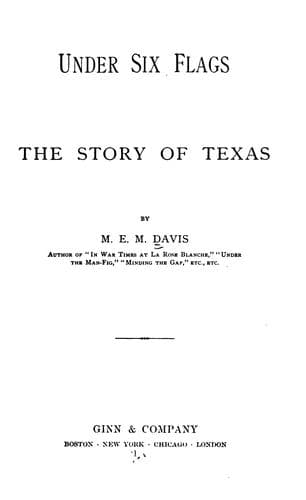
Under Six Flags: The Story of TexasDavis, M. E. M. (Mollie Evelyn Moore)
History
Under Six Flags: The Story of Texas
Davis, M. E. M. (Mollie Evelyn Moore)
Texas -- History
In October of the same year the Confederates, unable to hold Galveston,
surrendered that place to Commodore Eagle of the blockading squadron,
and withdrew to Virginia Point on the mainland about six miles distant.
Many of the citizens of the town also left their homes; and amid a
silence almost as profound as that in which Lafitte landed on the island
nearly fifty years before, several hundred soldiers stepped ashore from
their boats and took possession of the place. The United States flag was
hoisted on the Custom-house; the soldiers settled into their quarters on
one of the wharves; the imposing vessels of the Federal squadron filled
the bay and the harbor. A mournful cry echoed throughout Texas:
“Galveston has fallen!”
2. THE BLUE AND THE GRAY.
The holiday look had long since disappeared from Texas. No battles had
been fought within her borders, but the blood of her brave sons had dyed
the sod of many a battlefield elsewhere. For the deadly conflict was
raging. The North and the South, fighting as brother against brother,
were pouring out their kindred blood day by day; the smoke of their
hostile guns darkened the very heavens. Many heroic deeds were done on
both sides—deeds which to-day thrill us with wonder and admiration.
But there were frightful gaps in the ranks of those who had marched away
from Texas to the tune of “Dixie” or “The Bonnie Blue Flag.” The gallant
lads who had showed off their brave uniforms in the holiday camps were
tramping about, barefoot, ragged, and hungry, in Virginia, in Tennessee,
in Georgia,—wherever there was an enemy to be attacked or an outpost to
be held.
Their mothers and sisters at home were making lint and cartridges,
weaving and wearing homespun, making their own shoes and gloves, and
cheering the far-away “boys” with letters and with home-made gifts, and
praying, praying always.
There were few able-bodied men left in the state. The women with the old
men and boys, aided by the negroes who remained loyal and trustworthy,
made the crops. As the war went on the prices of everything rose. Old
bills show that forty dollars a yard (Confederate money) was paid for
calico for a little girl’s “best” dress; and seventy-five dollars was
paid for a boy’s first pair of boots. A war-time arithmetic has among
its examples the following:
“A cavalryman paid 200 dollars for his pistol and 4000 dollars for his
horse; how much did both cost him?”
“At 20 dollars a pound, how much coffee can you buy for 40 dollars?”
“If one hat costs 120 dollars, how much would eight hats cost?”
Coffee and tea were replaced by drinks made of parched potatoes, or
burnt peas, and sassafras roots. The real articles which were brought
into the country occasionally by blockade-runners were known as
“blockade” coffee and tea, and were kept for the use of the sick.
Public-domain text, read in full here on John Shaqi.
Reviews
Reviews
No reviews yet
Be the first to share your thoughts on this work.
Elsewhere in the archive
Join the Discussion
Join the discussion
Sign in to leave a comment or review.
Sign InorCreate an account