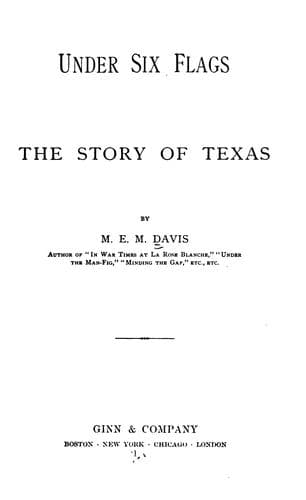
Under Six Flags: The Story of TexasDavis, M. E. M. (Mollie Evelyn Moore)
History
Under Six Flags: The Story of Texas
Davis, M. E. M. (Mollie Evelyn Moore)
Texas -- History
In the meantime, on the 12th of April, at Fort Sumter, South Carolina,
the first gun of the Civil War had been fired. The struggle between the
States had begun.
General Earl Van Dorn, of the Confederate army, was at this time in
command of the military department of Texas. His headquarters were at
Galveston. The island which the pirate Lafitte had left lone and
deserted when he sailed away in the _Pride_ now teemed with a busy and
prosperous people. The huts of Campeachy were replaced by stately
mansions, and beautiful gardens bloomed where sandy wastes had been.
Several companies of soldiers were encamped without the city, awaiting
marching orders. General Van Dorn entered the camp one day, and after a
brief speech called for volunteers for an expedition which he was about
to undertake. The Galveston Artillery, the Island City Rifles, and an
Irish company called the Wigfall Guards, at once stepped forward, eager
for duty.
The next night (17th of April), about midnight, the steamboat _General
Rusk_, with these volunteers on board, drew up alongside the _Star of
the West_, lying in the Gulf of Mexico, off Indianola. Captain Howe, of
the United States steamer, hearing himself hailed, came on deck, and
supposing these to be the United States troops he was expecting, he
politely ordered the _General Rusk_ to be made fast to his own boat. In
a twinkling the Confederate soldiers were aboard of the _Star of the
West_ demanding its surrender.
“To what flag am I asked to surrender?” asked the astonished captain.
Ensign Duggan of the Wigfall Guards displayed the Lone Star flag of
Texas, and in his richest brogue exclaimed: “That’s it! Look at it, me
byes. Did ye iver see the Texas flag on an Irish jackstaff before?”[38]
Captain Howe, having neither arms nor soldiers, surrendered, and the
_Star of the West_ followed the _General Rusk_ to Galveston.
This was why the United States troops the next morning (April 18) found
no steamer to carry them away. The two schooners upon which they
embarked were also captured several days later, having on board eight
hundred officers and men, with three hundred fine rifles and a large
quantity of camp supplies.
But the Confederacy had no means of protecting the long stretch of Texas
coast. In July a blockading squadron—that is, a fleet of armed vessels
to prevent ships from entering or leaving the harbor—was stationed in
the Gulf off Galveston, and in a short time the whole coast was closely
guarded.
In the fall of 1861 Frank R. Lubbock, who has been called the “war
governor” of Texas, was elected governor. By the close of his term
ninety thousand Texan soldiers were in the Confederate army.
Early in 1862 a Texas brigade, under General Sibley, was defeated by the
Union forces in New Mexico, and forced to retreat to San Antonio with a
loss of five hundred men.
Public-domain text, read in full here on John Shaqi.
Reviews
Reviews
No reviews yet
Be the first to share your thoughts on this work.
Elsewhere in the archive
Join the Discussion
Join the discussion
Sign in to leave a comment or review.
Sign InorCreate an account