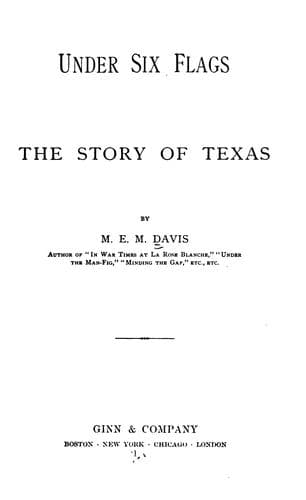
Under Six Flags: The Story of TexasDavis, M. E. M. (Mollie Evelyn Moore)
History
Under Six Flags: The Story of Texas
Davis, M. E. M. (Mollie Evelyn Moore)
Texas -- History
Aguayo, following the example of St. Denis, did not pause until the
intruders were safe in their own citadel at Natchitoches; then he
replaced at the Missions of Orquizacas and Aes the men whom he had
brought back with him, and he left for their protection a stout garrison
at the Mission of Nuestra Señora del Pilar (Our Lady of the Font), about
twenty miles west of Natchitoches.
He was as keenly alive as St. Denis himself to the natural beauty of the
valley watered by the San Pedro and San Antonio Rivers; and on his
return to San Antonio he set on foot many improvements, including the
widening and deepening of the irrigating ditches.
These irrigating ditches were called _acequias_ (a-sā′-kee-a). They are
still in use, and many of them are very beautiful. One known as the
Acequia Madre, or Mother Ditch, is as deep and wide as a small rivulet;
the living waters, pure and cool, rush along a bed lined and parapeted
with stone, and overhung with pomegranates and rustling banana leaves.
The water from the ditches is turned, by means of gates, into the fields
and gardens which lie along its course. Each landowner is entitled to so
much water a day, or at a stated period. This inflow of the crystal
flood is called the _saca de agua_ (taking the water), and is hailed
with delight as it comes singing its way through corn-row, garden-patch,
and rose-bower.
In the early days the completing of a water-ditch was celebrated as a
feast. Rows of cactus were planted on its banks to keep off cattle, and
shade-trees were set out along its course. A priest, attended by
acolytes, blessed the water. The following day a drum was beaten at
morning mass, and all those who had contributed in money or labor to the
making of the ditch were summoned to the church to take part in the
Suerte (soo-air′-ta),—a lottery for the drawing of the land watered by
the new sluice. Tickets were placed in an urn and were drawn out by two
children. The lucky holders of the highest numbers got the best lands.
At night, by way of winding up the feast, there would be a procession
and a _fandango_[9] on the plaza.
The good Marquis de Aguayo further recommended to the Spanish government
at Madrid to send colonists to the province. “One family,” he said, “is
better than a hundred soldiers.”
Then, having done all he could for the New Philippines, he went back to
his official residence at Monclova, attended as far as St. John the
Baptist by Captain Ramon.
4. INDIOS BRAVOS.
Public-domain text, read in full here on John Shaqi.
Reviews
Reviews
No reviews yet
Be the first to share your thoughts on this work.
Join the Discussion
Join the discussion
Sign in to leave a comment or review.
Sign InorCreate an account