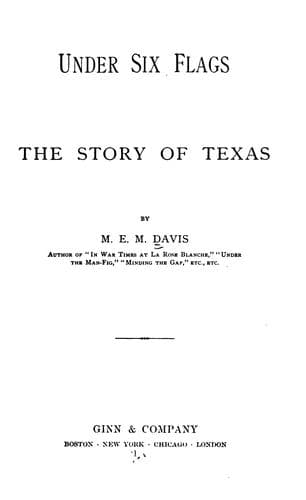
Under Six Flags: The Story of TexasDavis, M. E. M. (Mollie Evelyn Moore)
History
Under Six Flags: The Story of Texas
Davis, M. E. M. (Mollie Evelyn Moore)
Texas -- History
This victory (in 1732) gave some security to the place. The _Indian
bravos_ still harried the country, killing those who ventured far from
post and mission, and plundering where they could not kill. A number of
years later (1752), after a fresh quarrel with the miners at Las
Almagras, they fell upon the Mission of San Saba, and butchered every
human creature within its walls. But rarely did they again venture near
the dwellings of those determined pale-faces who had overcome them on
their own hunting-grounds.
5. ALONG THE OLD SAN ANTONIO ROAD.
The years drifted on, peaceful and sluggish, towards the end of the
eighteenth century. There were few happenings either in San Antonio
itself or in the province, which was at last laid down on the map as
Texas. There was no further dispute concerning boundary lines or
property. Spain was the lawful owner of everything west of the
Mississippi River. For Louis the Fifteenth of France, in 1762, for state
reasons, presented to the King of Spain the handsome French province of
Louisiana. The people of Louisiana were very angry when they
learned—more than a year after the transfer—that they had been handed
over without their knowledge or consent to the hated Spaniard. But Louis
did not trouble himself in the least about what they thought or felt.
Thus, the colonists being all Spanish subjects, were bound to peace
among themselves. Even the dashing St. Denis, had he lived so long,
could have found nobody to fight except the despised Indian. But that
doughty warrior and courtly gentleman had long since fired his last shot
on the field, and trod his last measure in the dance. According to the
old chroniclers he remained to the end of his life “a devoted friend and
a noble fighter.”
In 1729 a widespread plot was formed among the Indians in Texas and
Louisiana to massacre all white people within reach, Spanish and French,
men, women, and children. A friendly chief warned St. Denis of the plot.
He gathered his troopers hastily together and rode out of Natchitoches,
where he had continued in command, and in a short time defeated and
scattered the tribes. After this they hated and feared him, but they
looked upon him with awe, believing him to be protected by their own
Manitou.
[Illustration: The Cathedral of San Fernando.]
He was at length killed by the chief of the Natchez Indians. He lies
buried near the town of Natchitoches.
In spite of the peace between Spain and France (1762)—or perhaps because
of it—there was little progress in Texas. Spain forbade her colonists to
trade with other nations; she did not allow them to manufacture anything
that could be made in the mother-country, or to plant anything that
could with profit be sent over from there. They were even forbidden to
trade with their fellow-colonists in Louisiana.[10] Under these hard
conditions settlers came in slowly. Texas remained almost neglected,
peopled only by fierce savages.
Public-domain text, read in full here on John Shaqi.
Reviews
Reviews
No reviews yet
Be the first to share your thoughts on this work.
Join the Discussion
Join the discussion
Sign in to leave a comment or review.
Sign InorCreate an account