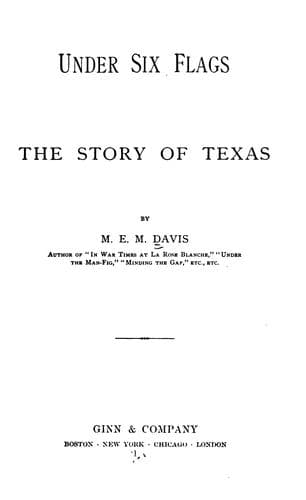
Under Six Flags: The Story of TexasDavis, M. E. M. (Mollie Evelyn Moore)
History
Under Six Flags: The Story of Texas
Davis, M. E. M. (Mollie Evelyn Moore)
Texas -- History
It had been occupied for a short time (1816) by a band of Mexican
“republicans,” under Manuel Herrera and Xavier Mina. They were joined by
Luis d’Aury, a Mexican naval officer, and Colonel Perry, an American who
had taken part in Magee’s ill-fated expedition. They set up a sort of
republic on the island. Their fleet of twelve armed vessels sailed the
Gulf, and for a time the enterprise prospered. But the little republic
did not last long. The leaders quarreled among themselves; the United
States denounced their sailors as pirates; the settlement was broken up,
and Galveston returned to its native solitude.
The island was covered with beautiful green grass; there were no shrubs,
and the only trees were three live oaks clustered together about midway
of the island. Its wide beach shone like silver in the sunlight. Here in
a short time Lafitte had established a miniature kingdom. Adventurers
came flocking to him from every direction, and in less than a year there
were a thousand persons on the island. Lafitte, bearing the proud title
of “Lord of Galveston,” held absolute sway over them. The fort and the
town, which he named Campeachy, were kept under strict military rule.
The bay harbored a fleet of swift vessels, sailed by fearless pirates
who swept the Gulf, capturing and plundering Spanish ships and bringing
the rich spoils to be divided by their chief. On the incoming Spanish
barques there were bales of silks and satins, woven for the dark-eyed
dames of Mexico, and soft carpets and priceless hangings for their
houses; there were rare wines for the tables of the viceroys, and
gold-embroidered altar-cloths for the churches. On outgoing Mexican
vessels there were bars of silver and ingots of gold, tropical spices
and dyes, uncut jewels, and beautiful skins of wild animals. All these
treasures were unrolled and spread out on the open square of the fort,
and each man was allotted his share. Lafitte was generous with the goods
brought in by his freebooters. Once from a rich “haul” he took for his
own share only a slim gold chain and seal which had been removed from
the neck of a portly Mexican bishop on his way to visit Rome. This chain
and seal were given by the pirate to Rezin Bowie, a brother of James
Bowie. It remains in the Bowie family to this day.
Besides the regular business of piracy, which was politely called
privateering, a brisk slave-trade was carried on between the island and
the shores of Africa. Slave-ships came boldly into the harbor and landed
their cargoes of black humanity at Campeachy. The negro gangs were
driven into the fort, where they were sold _by the pound_. The price
paid was generally one dollar a pound, though prices sometimes fell so
low that an able-bodied man or woman could be bought for forty dollars.
The purchasers hurried the unhappy Africans through the country to Baton
Rouge and New Orleans, where they were resold at higher prices.
Public-domain text, read in full here on John Shaqi.
Reviews
Reviews
No reviews yet
Be the first to share your thoughts on this work.
Join the Discussion
Join the discussion
Sign in to leave a comment or review.
Sign InorCreate an account