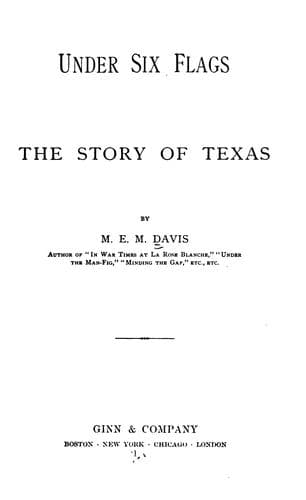
Under Six Flags: The Story of TexasDavis, M. E. M. (Mollie Evelyn Moore)
History
Under Six Flags: The Story of Texas
Davis, M. E. M. (Mollie Evelyn Moore)
Texas -- History
The Mexicans can hardly be blamed for their lack of confidence. They had
just shaken off the yoke of Spain; and they saw the Americans—people of
a different race, speaking a different tongue, strong, energetic, and
masterful—drawing daily nearer to the Rio Grande River. They saw this
alien people settling upon rich and productive lands, but paying no
taxes; giving nominal allegiance to the Mexican government, but taking
no interest in her political affairs. Added to this uneasiness was a
growing hatred of the United States, which wished to annex Texas and had
already offered to buy the province. Mexico resolved to crush this
rising power.
The Americans, on their side, were restless. They did not desire
absolute independence; but they wished for a separate state within the
Mexican Republic. They therefore, for political as well as for personal
reasons, resented the change of capital.
Still further changes were at hand. Bustamente (Boos-ta-men′tā), a cruel
and overbearing man, who became President of Mexico in 1830, on taking
his seat issued a set of laws forbidding Americans either to locate in
Texas or to trade with her people. In place of colonists from the United
States, criminals and disabled soldiers from Mexico were to settle the
country. The introduction of slaves was prohibited; taxes were put upon
almost everything in daily use; customhouses were established for the
collection of these duties; armed troops were quartered in different
places at the expense of the colonists; and military rules were
enforced.
It is needless to say that these laws were not obeyed. Texas was like a
nest of angry hornets whose center of action was at San Felipe; a buzz
of indignation filled the air; meetings were everywhere held to protest
against the injustice and tyranny of Mexico.
The excitement was increased by the arrest and imprisonment of some
Texans (1832) by Colonel Juan Davis Bradburn, an American in command of
the Mexican Fort Anahuac (An-ah′wak) on Galveston Bay. Among these were
William B. Travis (the future hero of the Alamo) and Patrick Jack.
William Jack, a brother of the latter, called a meeting at San Felipe,
where it was determined to resort to arms, if necessary, for the release
of the prisoners, whose offense was trifling.
The state of feeling was clearly shown by the number of men who declared
themselves ready to join in attacking Bradburn in his fort. The affair,
however, was settled without bloodshed. Colonel Piedras, the Mexican
commandant at Nacogdoches, hastened to Fort Anahuac. There, after an
investigation of the case, he released the prisoners and placed Bradburn
himself under arrest.
Public-domain text, read in full here on John Shaqi.
Reviews
Reviews
No reviews yet
Be the first to share your thoughts on this work.
Join the Discussion
Join the discussion
Sign in to leave a comment or review.
Sign InorCreate an account