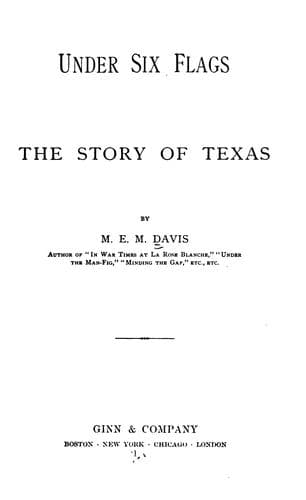
Under Six Flags: The Story of TexasDavis, M. E. M. (Mollie Evelyn Moore)
History
Under Six Flags: The Story of Texas
Davis, M. E. M. (Mollie Evelyn Moore)
Texas -- History
The Texan rangers were ordered out by Governor Wood to protect the
frontier. The Comanches, the fiercest of the western tribes, were
finally defeated by the rangers under Colonel John S. Ford. Their chief,
Iron Jacket, was killed in a desperate hand-to-hand combat with Captain
S. P. Ross. The chief’s tall form was found, after death, to be encased
in a fine coat of scale armor, supposed to have belonged to some
Spaniard in the days of the conquest of Mexico. Hence his name, Iron
Jacket, and the belief that he could not be killed by the bullet of the
white man. Iron Jacket’s little son Noh-po was carried to Waco, where he
was raised by the Ross family. During the administration of Governor
Pease, the legislature gave the Indians twelve leagues of land and built
for them several new trading-posts along the frontier. Later they were
all removed to the Indian Territory.
Two million dollars were set aside by the state for a permanent school
fund; and a quantity of land was voted for the support of the deaf and
dumb, the blind, the orphan, and the insane.
A new state capitol, a Land Office, and other public buildings were
erected at Austin.
In 1857 there was an uprising of Texan wagoners against the Mexican
cartmen, who were engaged in hauling goods from the coast towns to San
Antonio. Mexican labor was much cheaper than any other, and a large
number of these teamsters, who were honest and reliable, were employed
by merchants and planters. The Texan wagoners, failing to drive out
Mexican cartmen by threats, raided them on the roads, drove off their
oxen, broke up their carts, and in some instances killed the drivers.
Governor Pease, by ordering out a company of rangers to protect the
Mexican teamsters, finally put a stop to the “Cart War,” as it was
called.
No other trouble marred this bright period. “Our inhabitants,” said
Governor Pease, in his message to the legislature in 1855, “are
prosperous and happy to a degree unexampled in our former history.”
3. DYING RACES.
The Indian tribes who possessed the fair land of Texas when the white
man first set foot on its soil were rapidly dying out. Some were already
extinct, having left hardly a trace to show where their villages and
wigwams had once stood. The Cenis, that noble nation which welcomed La
Salle and nursed him tenderly when he lay for months “sick of a fever”
in their midst, and who sheltered the fleeing fugitives from Fort St.
Louis,—these had entirely passed away. So had the kindly Coushattis, the
friends of Lallemand’s colonists; and the Orquisacas, the Nacogdoches,
and all those gentler tribes by whose help the Franciscan friars had
built the earliest missions. Gone were the music-loving Wacoes from the
banks of the Brazos; and from the Trinity the corn-growing Tehas.
Public-domain text, read in full here on John Shaqi.
Reviews
Reviews
No reviews yet
Be the first to share your thoughts on this work.
Elsewhere in the archive
Join the Discussion
Join the discussion
Sign in to leave a comment or review.
Sign InorCreate an account