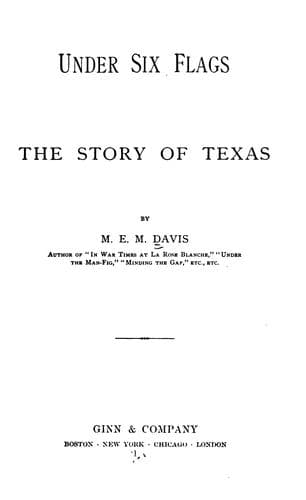
Under Six Flags: The Story of TexasDavis, M. E. M. (Mollie Evelyn Moore)
History
Under Six Flags: The Story of Texas
Davis, M. E. M. (Mollie Evelyn Moore)
Texas -- History
The fierce Carankawaes, once the terror of the coast and long believed
to be cannibals, and the Kiowas, called the _red-eyed_, had melted
before the coming of the pale-faces, as the snow melts under the April
sun.
But remnants of the warlike western tribes remained. The Comanches, the
Apaches, and the Lipans still hovered like dark clouds about the
frontier. They called themselves _Nianis_ (live Indians); and though
they were taken away by the government from their hunting-grounds and
penned up in a Reservation (that is, upon lands reserved or set apart
for them), they continued every now and then to swoop down upon their
old haunts, where every rock and bush and hillock was familiar to them.
Even within the past twenty years the borderman dared not be too far
from his rifle.
But the Texas Indian was passing. His tribes were dying out, as the
Mohicans, the Powhatans, and the Alabamas had died out before them.
With the Red Man, another race, as wild, as noble, and as free as his,
was as slowly drifting to its end.
When La Salle sailed up a certain pleasant stream in 1685, he called it
_Les Vaches_ (the cows), from the number of buffalos grazing on its
banks. They roamed the vast prairies and the shaded timberland, from the
utmost verge of the country on the north and west to the salt waters of
the Gulf. The herds were so large that the thunder of their hoofs
startled the air and their trampling shook the ground.
As the Indian retreated westward, the shaggy buffalo followed his
moccasined foot; as the savage warriors, who were as the sands of the
seashore for numbers, dwindled away, so dwindled the buffalo herds.
4. THE TEXAS RANGER.
The daring and ever-watchful foe of the Texas Indian, the dashing and
ever-ready hunter of the Texas buffalo, was the Texas ranger. He, too,
is passing away before the march of civilization, and fast becoming a
memory only; but a memory which will live forever in song and story,
with the brave, the generous, and the noble of all times.
The first company of Texas rangers was formed in 1832; but it was not
until the administration of President Burnet (1836) that this arm of the
service was regularly organized and put into the field.
They became at once a power, and they have since played an important
part in the history of the state. Mounted upon a swift horse, with a
_lariat_ (rope) coiled about the high pommel of his saddle and a blanket
strapped behind him; with his long rifle resting in the hollow of his
arm, and the bridle held loosely in his hand; erect and graceful, the
brim of his slouch hat hiding the sparkle of his keen eyes,—the Texas
ranger is a striking and picturesque figure. But he is more than that.
For fifty years and more he has been the terror of Indian and intruding
Mexican, of thief and desperado, of lawlessness and crime.
Public-domain text, read in full here on John Shaqi.
Reviews
Reviews
No reviews yet
Be the first to share your thoughts on this work.
Elsewhere in the archive
Join the Discussion
Join the discussion
Sign in to leave a comment or review.
Sign InorCreate an account