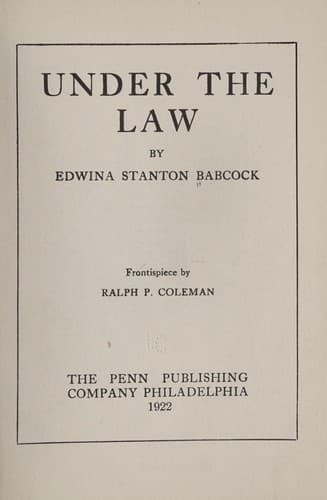
Amnesiacs -- Fiction; New York (State) -- Social life and customs -- Fiction; Trials -- Fiction; Young women -- Fiction
Outside, the summer morning was rich with promise. Butterflies sailed
two and two past the branches and down into the deep grass. The leaves,
turning over like little green babies on their backs, warmed their
little stomachs in the sun.
The summing up was short. Terry, his half-formed young ears pricking
up, heard it, only half understanding. Sard, Dunstan and Minga heard it
rebelliously. Dora, like a person in a trance, heard it stonily.
The criminal had done murder, so the evidence had shown, to obtain
money for adventure and to further schemes for his advancement. No
motive of personal hatred or self-defense or vengeance could be found.
The testimony had been full, accurate and to the point. Terry's curly,
well-brushed head was on his chest. Later it was raised and the boy was
staring defiantly around him like a young bull at bay and desperately
knowing only one thing, how joyous, how magnificent it would be to
charge!
Sard, sitting back in the court-room, looked from the boy, all the
muscles of his young back taut, to her father. It was to her suddenly
as if the whole court-room, all of them were, under the Judge's power
of punishment, and that somehow his whole life, all the whetted flavor
of his existence was to mete punishment. To the girl's daunted eyes,
her father was as powerful here as he was at the breakfast table. The
gray head was pompous and rawly defined against the background of the
American flag; the hard-boiled eyes looked with a peculiar fixity,
a muscular invariability on every witness; the nasal voice with its
few comments, swift interruption and rebuke, its lifeless adjustments
and refereeship of the proceedings were of an inflexible quality that
the girl felt was not of convention but of a hard, unimaginative,
self-secure and characteristic conceit.
So that when the counsel for the defense rose, three young hearts
in the assemblage arose with him. Yet to their passionate wish,
Watts seemed, standing in the court-room here, to fall short. The
distinguished figure, the face tanned with a summer of outdoor work and
horseback riding, sobered with long, lonely vigils of thought, had, it
seemed, great respect for this country court-room, for its judiciary,
for the foreman of the jury and for his opponent in the matter of the
trial. Watts carried himself like a man who had been impressed by the
firmness and sobriety of the proceedings. The lawyer let the court-room
know that he had had many personal talks with the prisoner. It was his
skilful way of assuring them that they shared his passion for reforms.
Public-domain text, read in full here on John Shaqi.
Reviews
Reviews
No reviews yet
Be the first to share your thoughts on this work.
Elsewhere in the archive
Join the Discussion
Join the discussion
Sign in to leave a comment or review.
Sign InorCreate an account