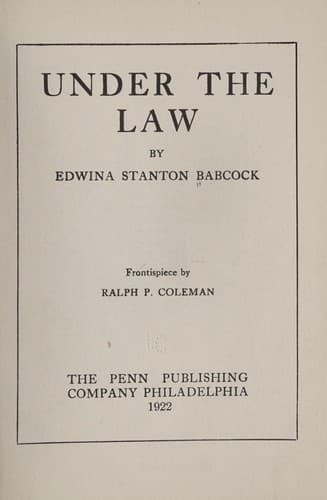
Amnesiacs -- Fiction; New York (State) -- Social life and customs -- Fiction; Trials -- Fiction; Young women -- Fiction
One arm crossed behind him, Colter began pacing restlessly up and
down the small space where the tree-chopping and wood-sawing had made
a little theatre. He spoke rapidly, disconnectedly. "I have come to
believe that I have been a college man. I even believe that I have had
certain honors. There have been achievements along scientific lines. I
can so far remember nothing in sequence back of the day Miss Bogart
found me. Since that I have a perfect power of memory." The man halted
and seemed to wait with a strained patience for things to pour in on
the open sensitive plate of his healing memory. At last, fishing in an
inner pocket, he held out a little book bound in green vellum. It was
very worn and had evidently been constantly read. "I have always had
this book, wherever I have been. For months it was the one real thing.
It was here, tucked back in a sort of envelope in the cover, that a
week ago I found an old letter from a man I once knew. When I try to
connect my memories with this man something profoundly horrible sweeps
me, and--and I grow full of panic."
Watts, with suspicions he could not control, reached out for the book.
At the same time he looked for anything that might further identify
this mysterious Colter. He peered almost with anger into a face so fine
and tempered in its sad look of opaque visions. Turning the opening
leaves, Shipman read in the little book, "Oxford, December 25, 19--to
M. L. from his fellow gypsy, Tarrant."
"Tarrant. Tarrant," the name arrested the lawyer. He turned sobered
eyes upon Colter. "Who is Tarrant?" he asked. Watts, with an annoyed
expression, wrinkled his brows. Where in thunder had he heard that name
Tarrant?
"I do not know," said Colter, "yet somehow, I believe it is someone I
have known."
Suddenly, as in a lovely picture, the man saw a June garden with the
Ramapo Mountains back of it. He saw distant daisy fields, a little
white gate, the tall wands of purple and blue canterbury bells; a
little boy sat cutting out paper dolls and a woman, whose dark blue
eyes were shy with him and whose voice had faltered as she had told him
a story and who had shown him a picture in a locket that she had drawn
up warm from her white breast. The woman's voice was always dreamily in
Shipman's memory. Now it told him a story.
The story of a West African expedition that had ended fatally,
disastrously, where the men died like sheep of smallpox, where George
Ledyard's brother, the famous biologist, Martin Ledyard, had striven
for the lives of the men, but had only been able to save three. Then
Dr. Ledyard had rowed down the tropical river with the body of his
dearest friend, the surgeon, Tarrant, in a canoe made from a hollow
tree. The natives, having deserted them, had left the scientific
party without canoes. Tarrant, Martin Ledyard's dearest friend, his
brother-in-science!
Public-domain text, read in full here on John Shaqi.
Reviews
Reviews
No reviews yet
Be the first to share your thoughts on this work.
Elsewhere in the archive
Join the Discussion
Join the discussion
Sign in to leave a comment or review.
Sign InorCreate an account