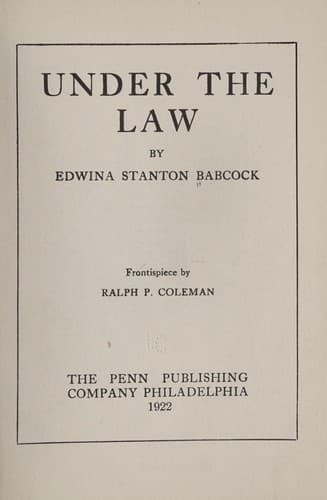
Amnesiacs -- Fiction; New York (State) -- Social life and customs -- Fiction; Trials -- Fiction; Young women -- Fiction
"Please put the north room to air. Miss Gerould arrives late in the
afternoon--I think there isn't a waste-paper basket in the room, so,
Dora, will you hunt one up, and see to all the electric bulbs, won't
you? And towels, the little embroidered ones----" Sard waited, half
contemplating, thinking of reproof for the back turned so rudely and
obstinately toward her direction, then she looked at the slight,
slender figure in its gray gown, the apron tied so carefully and
delicately, the capless, pretty hair, and was conscious suddenly of
someone young like herself. Through this veil of youth she saw what
kind of sorrow it was that bowed the head of the woman standing there;
something that she did not know was the most glorious passion in the
world beat up through Sard's heart into her brain; it was the passion
for humanity, for justice and fairness for all. "Why should I be
giving orders to her when she is suffering? Supposing Dunstan were in
trouble and--and shame, and I had to take orders from the very people
that----Dora--Dora," the girl persisted, "is there nothing I can do?"
There was no answer, only dry coughing sobs. The cook turned. "Ah,
don't bother your head with it all, dear. It ain't nothing to
you--only, Gawd help the poor thing! Er course," said the cook somewhat
bitterly, "we're all under this law; the boy done wrong; he done awful,
and they'll be able to prove it against him, and your papa--well," the
cook sighed, "only he's young, a rill smart curly-headed young feller
and his chanst is gorn."
Then cook, with a curious rising howl, turned away herself.
Wiping her eyes, the young waitress stonily piling up the silver on the
tray, let drop a fork. The girl stood there looking at it. Sard tried
to comfort her.
"It--it is Human Sorrow," she said awkwardly. "I think we--we don't
understand sorrow as well as we ought to and I am quite powerless but
Miss Aurelia and I care, Dora."
The girl said it tremulously; already she was feeling the awful
gulf between a person who suffers tragedy and that other who stands
by longing to help. Also Sard knew a kind of shame--for it seemed
treachery to her father and the equity he maintained, to say more. What
could words do? It was Sard's first experience of the great naked fact
of human sorrow and shame; she knew that the only person who could help
Dora would be someone who had been through a wave of tragedy like hers.
"Words," thought Sard hotly, "are disgusting. We bandy them about and
pile them up like money. We exchange them like coin of the realm." The
young girl, clean and defiant of emotion as a young animal, had no
mature power, that amazing power borne through sorrow and sympathy, the
strange power of the healing touch, else she would have touched Dora's
bowed head, put a comforting hand on the heaving shoulder. She stood
silent, then once more said, helplessly, "Dora, don't you believe me,
that I do truly care?"
Public-domain text, read in full here on John Shaqi.
Reviews
Reviews
No reviews yet
Be the first to share your thoughts on this work.
Join the Discussion
Join the discussion
Sign in to leave a comment or review.
Sign InorCreate an account