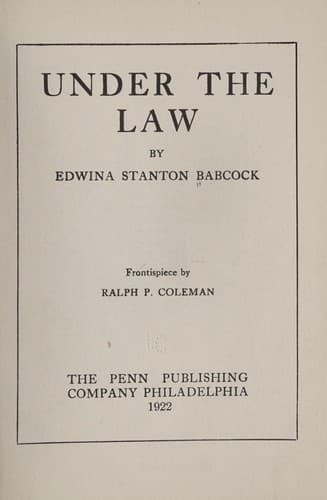
Amnesiacs -- Fiction; New York (State) -- Social life and customs -- Fiction; Trials -- Fiction; Young women -- Fiction
The house seemed to ache with loneliness and the desolation of souls
at variance. There was no noisy gathering of the Bunch on the porch
of the Judge's home. Miss Aurelia worried over the absence of Minga
and Dunstan. She had retired early to "collect her thoughts," she told
herself, supporting this enterprise by taking with her a novel by which
her friend, Mrs. Spoyd, set great store and which, so its owner told
Miss Aurelia, contained "not one unpleasant thing." Miss Aurelia who
read a chapter out of "Something" every night, now read a blissful
chapter out of this novel. Here there were such minute descriptions
of crockery and curtains as delighted her soul; here married people
all "got on" well; in this book the children arrayed in fresh pinks
and blues played happily with clean spools or pretty blocks against
backgrounds of hollyhocks. The little brooks ran without roiling, mad
dogs kept away from villages and arranged their lives to be killed when
convenient by intrepid lads educated for the purpose. The minister was
handsome, good and healthy, and said what was expected, the doctor
cured all fractures whether of skull or mind, the tax collector sent in
his bills only when people had the money, and the young people sprang
up together in couples like Noah's ark and married and started on a
wonderful advertisement-perfected housekeeping.
"Why?" asked Miss Aurelia, yawning and settling down for the night.
"Why don't more people write pleasant books and plays like this? I
think all writers who write disagreeable things should be snubbed and
made to feel uncomfortable, they should not be asked to dinner nor
treated politely in any way until they stop writing about slums and
dirty people and of unpleasant married problems. That," said Miss
Aurelia, putting out the light, "would soon discourage them from
writing horrid books, and then life would become normal and we should
forget the things we don't want to think about. I should think,"
soliloquized Miss Aurelia, putting her handkerchief under her pillow,
"that writers should realize that unless they write only about normal
things that they will never be popular."
It was after ten, but Sard had not gone up-stairs, yet the figure of
the Judge, sitting aloof in one corner of the piazza, smoking and
staring at the river, magnetized while it antagonized her. Her father
had not spoken to her since the day Colter went away. The girl believed
that he knew in some way that she had met Colter after his forbidding
it. She could explain the seeming disobedience of this final interview.
She wanted to explain it. With all the misery of her young heart she
wanted to explain.
Public-domain text, read in full here on John Shaqi.
Reviews
Reviews
No reviews yet
Be the first to share your thoughts on this work.
Elsewhere in the archive
Join the Discussion
Join the discussion
Sign in to leave a comment or review.
Sign InorCreate an account