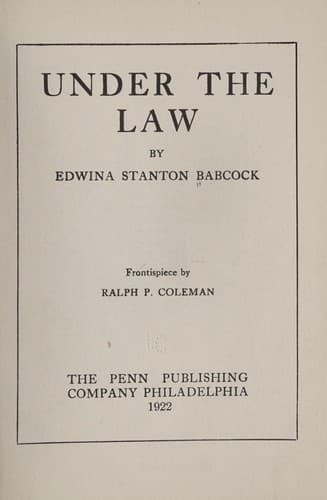
Amnesiacs -- Fiction; New York (State) -- Social life and customs -- Fiction; Trials -- Fiction; Young women -- Fiction
Late that evening Miss Bogart heard the phonograph circling forth
the "heart bowed down with weight of woe."... She turned another
page in the "pleasant" book. "My poor brother," said Miss Aurelia to
herself; "he seems to turn naturally to the--er--melancholy--but I
should think," the lady thought sleepily, "that now that Colter isn't
Colter at all, but the celebrated scientist Dr. Ledyard, that he, she,
they----"
CHAPTER XXVII
THE JUDGE IS IMPRESSED
It was late September; the yellow maples threw gold on sky and ground;
oaks and hickories were mantled in ruddy purples. Along the banks of
the river the solemn procession of outgoing summer was begun; on dry
nights mountain fires spread crackling smoky fringes. The Westchester
hills, the hills of Pocantico, were trailed in grape-colored mists;
bloom was on the Ramapos; amethystine smokes along the Highlands and
the Palisades.
There was drowse and arrest in the air, a kind of heat that was
different from summer, more dazing, more intensely keyed, with greater
power to make one restless. Sard, lying on her couch in the tower-room,
felt as if a world was closing in on her, as if the sky pressed and
the hills leaned to smother. She had been reading to Dunstan, for the
first time sitting up in his wheeled chair, had seen him drift off to
sleep, and had then put down her book with an unconquerable sense of
listlessness, of lack of purpose that had somehow closed in on her.
The girl, her body and mind built for action, for creative and
progressive things, found herself victimized by a slowly narrowing
circle of life, static, unimaginative, unprogressive; she was the fiery
center of a wooden wheel of existence that revolved in accustomed
sameness with no effort, to no purpose.
"When Dunstan gets well," thought Sard desperately, "when Dunstan
doesn't need me, what shall I do then? Aunt Aurelia doesn't really
need me, Father will have nothing to do with me unless I--just--just
capitulate. And I can't do that. What shall I do?"
The girl's mind, shrinking from her father's idea of her, went over
the situation; the only way to clear up that situation was to say she
had been mistaken in Colter, that she proudly told herself she could
never do. But supposing Colter never came back, never--came--back to
Willow Roads? Life would go on the same and, of course, one could adapt
one's self to anything; with a shiver the girl tried to think what this
adaptation would mean.
Public-domain text, read in full here on John Shaqi.
Reviews
Reviews
No reviews yet
Be the first to share your thoughts on this work.
Elsewhere in the archive
Join the Discussion
Join the discussion
Sign in to leave a comment or review.
Sign InorCreate an account